Thursday, 22 August 2013

Spring end of semester exam results

おひさしぶりです!(Long time no see!) Finally back from all my domestic trips. I hope to document each of my trips in more detail in individual, dedicated posts in the coming week. I am aware that I've said similar things in the past, and nothing came to fruition, but this time, there's one difference: holidays have started! Technically, holidays started on July 20th, but it hasn't felt like it till now.

So this post is the first of many overdue posts. I came back from my final trip this summer holidays on the 17th of this month, but I have been cramming flat out for my PTC correspondence exam since that time until today, when I finally sat it. To give an update on my previous post, I have turned down the Japan Tent international exchange, made my (possibly more than one) would-be homestay family very sad by cancelling, and instead committed to studying the remainder of the PTC course to the best of my ability. After all, I'm not doing this course for marks alone. The whole reason I began it was to get to know the Bible better, and it would defeat the purpose if I studied merely to pass. So I sat the two and a half hour exam for Introduction to the Bible at 2pm today, and used up the entire 2.5 hours. The good news is that I could answer almost everything, so it showed a good understanding of the subject content, praise God! Report of results will come in time. Thank God for the generosity of my church pastor who served as exam supervisor and made this all possible!

In the meantime, the following table displays my results for our end of semester 1 exams. I intended to write this on the 19th of July, when we got our exam results back, but haven't until now sorry >.<

Japanese speaking
90
Japanese composition
88
Japanese listening
100
Kanji writing/reading
100
Japanese grammar
98
Politicoeconomics
79 91
Japanese history
99

I figured there are numerous benefits to putting up my results here. Since my official job at the moment is student, I'm sure people back home want to know how I'm faring in that department, so I'll let my results do the reporting. Another good reason is that this will help me keep track of my exam results, as we have been advised to do.
I'm thankful to God for the marks that have eventuated. Our responsibility is to make the most of the opportunities and abilities he's given each of us, but the outcome is up to him. As I like to phrase it, trust God and do your best, and God will do the rest. Whether I get 45%, 65% or 95% doesn't matter; God will give me what he deems best.

These exams have on the whole been well structured in achieving their purpose of assessing our progress. We had to fill out a questionnaire on the quality of the teaching in the semester, and my responses were largely positive. The one exception, however, was politicoeconomics, as I vented at length in a previous post.

You'll notice that the dodginess of the subject is reflected in my mark above. The mark change was approved when I spoke with the teacher who set, marked, and reviewed the exam (without any cross-checker). Why did my mark jump from 79 to 91, you might be wondering? The whole difference came from one question. And that question, was entirely a mathematical one.

Because venting in only one post isn't enough for me, I'm going to vent again that you don't set arts students maths questions in a timed exam. Or if you do, at least do some practice in class, or actually tell us before the exam so we can practice. The question I lost most of my marks on was a question that required us to look at age statistics and calculate population proportions using raw data. We did look at the same data in class, but the teacher did not get us to work out a single math problem in class or for homework. He then proceeds to set us a 15 mark question, of which I only got 3 initially. To be absolutely clear, I understood the concepts and formulae needed to work out the numbers. So after I reasoned with him that I demonstrated my understanding by writing down all the formulae correctly and had written down the relevant figures but that we weren't allowed a calculator and I ran out of time calculating, he finally consented. I wonder how many other students in the class lost marks not because they didn't know their stuff, but because they couldn't divide 66,987 by 12,692 without a calculator. Yes, I bring shame upon my Chinese family. To give the full story, I admit that yes there was a shorter way by using alternate data on the sheet, but that still involved dividing something like 89.1 by 26.8 without a calculator and without being warned before the test, which is my primary complaint, and I maintain my position.

In any case, the first term marks don't count for this subject (precisely because the university knows unexpected things like this happen). So it doesn't matter whether I got 79 or 91, it doesn't affect anything. However, I strongly dislike the structure of this subject.

Friday, 26 July 2013

Start of summer holidays! Time to - get busy…?

It's been one week since end of exams, and one week into the summer holidays - and boy has the past week been busy. Before I realised it, it's approaching the end of the month, and I've only written one blog post (excluding this one) during this time. And that's not about to change (the busyness, and not the sporadic posting, hopefully) as the summer holidays progresses, and here's why.

----------------------------------------
20 July - Holidays began

26 July - Today
27/7~5/8 - Shizuoka homestay program (where Mt Fuji is)
6/8 - Day out with KGK Christians at Tama Church
10/8~12/8 - Driving around Tokyo with Dad

18/8~25/8 - PTC exam period
21/8~28/8 - "Japan Tent" International Exchange in Ishikawa Prefecture

2/9 - Second (autumn) school term commences
----------------------------------------

Phew. Even contemplating such a plan overwhelms me. As you may have noticed, the Japan Tent trip and the PTC exam period overlap. Which is a problem, since the pastor from Tama church and I had previously arranged to have the exam set on 24th August. That's a bit of a problem. The problem is that I was only notified by the Japan Tent people yesterday that I was accepted, so I couldn't factor that into my summer planning. I always have the option of moving my exam earlier, and being able to attend the Japan Tent, but it depends upon the pastor's availability and even then, I will have virtually no time left to do my summer homework (which I haven't started). Please pray for wisdom in how to navigate this decision, what to keep and what to sacrifice.**Update, I have withdrawn from Japan Tent, to opt for more study time for the PTC.


A shout out to those back in Australia who came back from MYC and AnCon respectively! I can see on Facebook that it was an edifying time of delving into God's Word and fellowshipping with one another. I hope to join you guys same time next year when I come back to visit during my holidays :)

Tuesday, 16 July 2013

End of Semester exams - Sem 1

Six down, two to go! One today, one tomorrow.

To view full size, right click and select "Open image in new tab/window"

On Friday I had Japanese reading, composition, and Japan politicoeconomics. Reading was easy, but that means I had to be extra careful not to lose marks on silly errors. The composition was fairly ok, but I won't be expecting a perfect score. The question was easy enough - pick any experience in Japan so far, and write a structured, coherent piece 600-800 characters in length in 70 minutes. The time pressure was very stressful for some people though. The girl sitting next to me in the exam was from the top class (class A). With 20 minutes left to go, she had only written 400 characters. One friend only managed to write 400 characters in total when time was up (incomplete composition). So it was definitely not an easy test.

The politicoeconomics test has been the worst by far. The reason why it was so bad wasn't primarily due to difficulty. The worst thing about this subject was the course structure, from week 1 to final exam. As someone aspiring to become a teacher, I have a lot of criticism about how this subject was run. It's obvious that all of us are still getting a grasp of Japanese, so we will struggle with language. But instead of going through and explaining possibly difficult concepts in the written material (which, goes without saying, should then be assessed), the teacher chose to use a mix of sparse Japanese and poor English to talk about topics largely unrelated to the written content. Having poor English wasn't the teacher's fault, but forcing us to computate unfamiliar content in near unintelligible English wasn't a very smart teaching method in my opinion.
Furthermore, this has been the only class so far where the learning objectives of the course haven't been clearly outlined. We found out which topics covered in class would come up in the exam, and still, we didn't know what the exam structure would be - will we be writing short response? Multiple choice? Calculations? We were all caught unawares when what we were assessed on was largely our ability to write kanji, our mathematical ability, and ability to memorise tables of figures. Firstly, fair enough that we should be expected to know the Japanese word for GDP and GNI (gross national income). Of course we touched upon them in class, but not once did he write out those kanji for us, or hint that it was of great importance. I studied them because I personally wanted to learn them, but I never expected a direct question asking "write the kanji for GDP". Also, this is not a subject testing our mathematic capability. However, I literally spent 3/4 of the one hour we had for the test trying to divide 28,980/58,460 to find the ageing index and figuring out which three foreign nationalities in Japan had the greatest increase between 1960 and 2010, using a table of 30 countries. Again, it would not have been so bad if we had been told beforehand of our expectations for this course. But I honestly had not idea we would be required to calculate figures on such a minute scale, and I have a feeling I wasn't alone. On top of all of that, there was even one question directly asking us to identify the four countries whose names had been removed from that table, by looking at their population growth from 1960-2010. China, Korea and Brazil were countries brought up in class, and they were reasonable to assess us on. But why Philippines…? As far as every member of our class is concerned, we did NOT talk about the population of Filipinos in Japan. I am VERY annoyed that not only did he never hint at our need to study the six (ridiculously) detailed tables we'd been handed out in the possibility we'd be asked to fill in one of them, but that he even chose a piece of detail that wasn't of prime importance.
Lastly, and most importantly, there was not one question testing our understanding of politicoeconomic concepts. It would have been nice to be asked to explain what GDP was comprised of, or even how the GDP of Japan has changed over the past 50 years, which were topics covered in class, but not even slightly required in the exam. In short, this exam didn't assess our grasp of the overall aims of this course at all, and for that reason, it was a poorly thought out test. After hearing the feedback from his students after the test, even our teacher had second thoughts on putting so many calculation based tests into an hour-long exam. I get the feeling he didn't try very hard in teaching us, for most of the semester, using my own experience of teaching children over the past nine years as reference.
Here ends my venting. Needless to say,  I will be writing all this in the feedback survey we will be receiving at the end of the exam period. It negatively affects the learning ability of everyone taking this course.

Between our first day of exams (last Friday) and the second, we had a long weekend - yay! It was called Marine day, and I have very little idea of its significance up until now. Maybe I'll do a bit of research later on. Anyway, it was a much needed long weekend, to study Japanese history. I'm not exaggerating when I say there was an obscene amount of content that had to be remembered. I think I learned to write the same amount of new kanji over the three-day long-weekend studying for history as I did for this whole semester of Japanese class combined. Not to mention, we had to learn the significance of these words as well (though that was much easier than learning the words themselves since they were all related). I must have spent 75% of my waking time over the long weekend (amongst eating, attending church, and not showering) studying for history, and 75% of that time learning kanji.
The other two tests, listening and grammar, were not too bad. Again hoping I didn't make silly mistakes, because I checked very carefully.

Today is the speaking test, which will involve receiving a topic, being given 30 seconds to think about what to say, and one minute to say it. We will receive two topics in total. Not much I can do in the way of preparation for that, so it gives me time to write this ^^

On Friday, we get all the results back. At no point in my Australian school education experience have I ever received back an end of semester exam result so quickly. Only in Japan.

So this post turned out a bit longer than I intended it to be ^^" Apologies again for ranting.

Wednesday, 3 July 2013

Addressing my first Japanese letter

Yesterday, I addressed my first envelope in Japanese. These envelopes contain invitation letters to Aikido practitioners from dojos affiliated with the one at TUFS. They are for the upcoming TUFS Aikido club camp. For privacy reasons, I photographed only the back of the envelopes.


It was indeed an important life lesson in living in Japan. Making mistakes is a learning process, and in the process of addressing my first Japanese letter, I indeed made quite a few errors. These included writing the name off centre, writing names too small or too big, irregular spacing between letters, and of course, incorrectly writing names (or addresses). In Australia, if I made an error whilst writing the address, I would probably either cross it out or white it out and correct the error. However in Japan, by any standards, that is not acceptable. If you sent a letter with corrections in the address or the name of the recipient, that is considerably rude and disrespectful. The point of writing a letter is to convey to the recipient that they are valued, and it defeats the purpose if the addressing is sloppy. Of course, in Australia, such meanings also exist, but definitely not to such an extent. This experience gave me further insight into the high standards expected of all citizens in Japan. It appears every citizen carries out their duty in upholding that expectation, and in my case, teaches ignorant foreigners how to do so as well.

Wednesday, 26 June 2013

Good morning!

Hey everyone, Lee here again, crawling out of dormancy. Sorry for the long delay since my last post (and my last prayer newsletter). I never quite caught up with studies AND had spare time to finish my Hokkaido trip recount till today. Well, I still don't have much time, but I'm going to post this anyway.

It's amazing looking back, how much ground we've covered in just under three months. I'm told it only gets busier from here.

A certain habit I have, which some may even call OCD, is that if I start something, I will make sure that it will be done justice, otherwise I won't begin at all. It works out as a good habit for most things in life, but when it comes to keeping those back at home updated on my time in Japan through a blog, particularly in a year as busy as this one, it's kind of unrealistic to spend two hours per post. Plus, I am fully aware of tl;dr. I don't like reading long posts either, particularly when they're not written in a very engaging style. I promise that my Hokkaid trip post will be my final long post. It will be difficult to force myself to keep posts short and sweet, but that is something I need to learn. Be praying I will keep that up, so that I can share updates more regularly.

I am deeply grateful for those who noticed my lack of activity on my blog; it tells me people actually do, and want to, hear how I'm going in Japan. So special thanks to +Gabriel Fong, +Sam Chua and +Michael Tong for checking up on me. You guys motivate me to keep going. I will hopefully be able to dedicate a post to it in the near future, but for the moment, in short, my walk with Christ is well. And I am looking forward to whatever this year will bring.

Again, please pray for consistency in publishing blog updates. It's not something I'm used to doing, nor something I'm good at yet, but it's what I want to sustain. Please also pray the same for sending prayer newsletters, to those who have sustained me through prayer while I'm here. Lastly, pray for the time leading up to our first important exam (it actually counts this time) - the end of semester 1 exam period from July 12-18. There's a considerable amount to study, and a significant standard of performance to meet. I am also aware that it overlaps with MYC for CBS at UNSW. I'm praying for God's word to work powerfully in those who will be in attendance. May God work powerfully to build up the body of believers to live and speak in truth and love. For those who are reading this also, pray particularly for the first years, that they might be equipped to be salt and light amongst their new classmates and in their new classes.

A parting word from the memory verse at Tama church this week:
For you are saved by grace through faith, and this is not from yourselves; it is God’s gift. Eph 2:8 (HCSB)

あなたがたは、恵みのゆえに、信仰によって救われたのです。それは自分から出たことではなく、神からの賜物です。 エペソ人への手紙、2章8節(新改訳聖書)

Sunday, 5 May 2013

Sapporo Trip

A friend from Australia graduated from UNSW last year, just like me. Unlike me, Nina studied commerce, and will be commencing her job at a firm in Sydney around June. Until then, she is in Sapporo, Hokkaido, on short term mission with OMF. I thought I'd make the most of this golden week break and drop in for a visit before she left. Selina also came to visit in the same period. This is the document of our Golden Week adventures.

(Note, I don't show pictures of others on this public blog without express permission. I've included links to these pictures which have other people in them on Facebook (kudos to Selina for taking and uploading them all!), so if you have permission to view them, you can.)


Departure and Arrival


Strange weather
Sapporo wasn't as cold as I expected. Everyone kept saying that the weather there is not receptive to visitors outside summer, but I walked around with a shirt and a jacket (two layers) and it was quite comfortable. Upon initial observation, it appeared all the snow had melted from the roads, but I saw quite a few piles of snow around the place which suggested they cleared the snow manually.
  
Something very strange was that the cherry blossom trees in Sapporo had not yet started to bloom by the end of Golden week this year (which was when I was there). Japan has a unique obsession with cherry blossom trees, which they commemorate with an annual celebration called Hanami. I'll get around to writing more about Hanami at a later time, but the main feature that makes the cherry blossoms beautiful to the Japanese is its brevity. These trees flower once a year, and the flowers drop off in four or five days. Flowering season in Tokyo is supposed to be early April, so I should have arrived in Japan on time (April 1) for the peak flowering period. But due to strange weather patterns, the cherry blossoms well before their usual time, so it means I didn't make it. This time in Sapporo, the cherry blossoms didn't bloom till after their expected season. Very strange weather patterns - I'm disappointed I didn't make in time for hanami this year :( There's always next year I guess.

Sapporo beer museum


The first stop on tour guide Nina's itinerary was the Sapporo beer museum. We had the visit placed on the afternoon I arrived, but due to the arrival time of my flight, by the time we got there, the museum had closed :(

We still got something out of it though. Sapporo is famous for Genghis Khan. Not the war general; he's Mongolian. In Japan, ジンギスカン (jingisukan) is lamb BBQ on a hot plate.


There were a number of specialty Genghis Khan restaurants at the Sapporo beer museum, so we went there for dinner. The service there was really good - they gave us plastic bags to cover our coats and bags. Why, you might ask? Let's just say I didn't want my bag to take BBQ lamb back home as a souvenir. I enjoyed our Genghis as thoroughly as our clothes smelled of lamb at the end of the night. And no better compliment to the succulent lamb than a hearty pint of Sapporo beer. And Nina, thanks for your generosity in shouting us - you really didn't have to, and we are deeply indebted to your hospitality.


Visiting Hokudai
The next morning, Nina showed us around Hokkaido University (北大 hokudai), where she had spent most of her time in Sapporo. I didn't know Hokudai had such an interesting history. It's best known as one of Japan's national universities, but I don't think it's widely purported that its founder is a Christian. According to Nina, the Christian staff workers at Hokudai told her that apparently one of William Clark's demands was that he be permitted to teach Christian theology on campus. His article on Wikipedia certainly suggests he fought very hard to have the study of thelogy approved in what would have been a country largely unacquainted with Christianity, and the current motto of the university, "Boys be ambitious", was quite possibly originally "Boys be ambitious for Christ". I'm certainly impressed by the missionary efforts of Clark, and what he achieved inspires me to be ambitious for Christ also :)


Taboo numbers?
I noticed something very strange about the room numbering on my floor. What I discovered takes superstition to a whole new level. Level 6 to be exact. (because that's the level I was on when I recorded this video).


Sapporo International Church
On Sunday, we all attended Nina's regular church together, SIC. It was a service conducted in Japanese, with real-time English translation provided via an earpiece for those who wanted it. The pastor was actually a Korean OMF missionary, and not a Japanese native, which is really surprising, since Japanese churches usually preference Japanese pastors. I suppose it shouldn't be too surprising, since this church is more internationally orientated. Aside from a very slight accent, his Japanese was native anyway, so that wasn't an issue.


The sermon style was also quite different to the customary three-point sermon from a reformed evangelical church. It was difficult finding one major theme that ran through the sermon, though. I guess I'm not used to that sort of preaching style yet. It would also have helped in retaining the anecdotes if I had understood more Japanese.

Mount Moiwa
We took a ropeway up Mount Moiwa, a 531m high mountain with an excellent view of Sapporo city.


Sapporo Ramen

We tried the ramen at the most renowned ramen shop in Hokkaido. How do I know that it was the most renowned? Well firstly, this shop has been running now for three generations. Secondly, both the owners and their huge flashing sign outside say that it is. But most interesting of all, was what was on the wall inside the shop:

(click to enlarge)

These are signatures from renowned people who have come to eat here. They are almost all Japanese though, so you might not be familiar with many, but I reckon most people know AKB48 (rightmost framed canvas, middle row). I also recognised Aqua Timez. You might be able to find another artist you recognise. The restaurant owners told me that they have more signatures from visiting celebrities than they have room in the shop to display. I believe them.

Between the three of us, we tried their salt butter ramen, soy sauce butter ramen, and miso butter ramen. Personally, I liked the soy sauce butter ramen best. But I just simply love ramen full stop ^^


Marimo
Some friends here in the dormitory asked me to bring back Marimo as a souvenir. At that time, my response "was what on earth is a marimo…?" It turns out that they are apparently quite well known. Have you seen or heard of these before?


According to Wikipedia, aside from Hokkaido colonies are only found in Iceland, Scotland and Estonia. Also according to Wikipedia, they are considered a type of plant. So apparently they will grow bigger, but only apparently about a millimetre per year. I guess we will see, assuming my one doesn't die before that.


Trick(ed) art museum
We heard that there was a trick art museum exhibit being hosted in Sapporo, specially for the Golden Week break, and I was interested. Selina had to catch her flight, so we said goodbye to her first before Nina kindly acted as guide one more time. What we didn't consider, was the waiting time to enter the exhibit. I thought the exhibit might be popular, but to be honest, I didn't expect the wait to be 90 minutes long. It seems I wasn't the only one who was shocked by the wait time. Since there was about 3 hours before my flight back to Tokyo, in order to allow for the train back to the airport and check in time, we thought better than to risk missing the plane. Slightly unfortunate, but on the flip side, we got to have Okonomiyaki instead :D


This was my first time eating Okonomiyaki, and it also happens to be my first time making it too. Nina learned how to during her time in Hokkaido, so she taught me how. The flipping part was the hardest, but more or less it remained intact. It wasn't too shabby, if I say so myself! By not going to the trick art exhibit (which is available in many places anyway), we got to eat a hearty lunch, and have fun doing it :) An exchange worth making.


Interesting street architecture
Despite less than two hours remaining of my time in Sapporo, the eventfulness doesn't end here. We happened to walk in the opposite direction to the train station on our way back, and did so for 10 whole minutes. Why did it take so long for us to realise? Well here's a screenshot of the street layout of the centre of Sapporo. What do you notice?


The streets are virtually all at right angles to each other. The grid-like street architecture is further accentuated by the street name designations - "kita" means north, "nishi" means west, "minami" means south, and "higashi" means east. It was pointed out to me by a friend back in Tokyo that it quite resembles New York street architecture (and naming).


Anyway, we were supposed to go to Sapporo station, so making our way to the equivalent grid co-ordinates of 7 North, 1 West, but instead we went in the opposite direction (i.e. VERY north). The street names don't change very much, so it didn't dawn on us till we got to somewhere around 20 North. A note of caution for anyone going travelling in either Sapporo or New York.
Needless to say, it took us quite a bit longer to make it back. I ended up taking the last train I could without being late, and checked in at the airport 1 minute before the check-in counter closed. Human failures let us down again, but God was good to us as He has been always.

----------------

Big thanks to Nina who organised the whole weekend, despite her busyness both before and after our visit. Prioritising being a good host over (a long overdue) sleeping in, you showed great hospitality :) Praise God also for your willingness to serve Him in a foreign country, sharing the good news of Christ with those who don't yet know Him. God bless in your future ministry, wherever God takes you :)

Visiting Musashi Sakai Red Cross Hospital

First of all, a big public thanks to everyone who has been praying for me. I can attest that your prayers have made a difference, and been a huge encouragement to me. I know that God has been good in answering prayers I've requested, but also prayers I've prayed for others. I was informed by +Michael Tong in our google hangout last night that a non-Christian who visited our church back in Australia whilst I was still there, has attended on numerous occasions, as I prayed that he might. But again to exceed my expectations (and everyone at church, it seems), he has been reading the Bible at home of his own initiative! Praise God. Aren't I concerned he might see this post? I think it would be a good thing for him to know people have been praying for him!
And I don't know if it was because you prayed that I'd get better, +George Mason, but your prayer has been answered, haha. As I promised in an earlier post, I'm documenting the outcome of the specialist visit last week Friday. Apologies for the time delay; it's been a full on week. Also, happy golden week everyone!


I didn't understand everything that was going on, because my Japanese is still limited, but as far as I could ascertain, there were no GPs in this hospital. Since every person who goes to the hospital has at least some idea of what abnormal condition they have, from the beginning you ask for a doctor specialising in the field you want further examination in. For example, I was referred to the respiratory specialists ward. I also saw a neurological ward and a pathological ward. I suppose if you somehow caught three different types of illnesses simultaneously, it's up to you to go to each respective ward for the check-up.

The next thing I was surprised about was how young the doctor who I consulted was. He was a respiratory specialist no doubt, but he looked younger than 30 - although I have noticed that Asians generally look younger than their actual age. So anyway, his diagnosis was the same as the doctor at the university, 咳喘息. No photo of the doctor either. Asking the doctor for a photo would be quite strange.

What was also strange was the design of the medicine, although "different" might be a better description than "strange". Can you guess what the purple thing is used for?


On right left are tablets, but they are seriously tiny. Each tablet was the size of a pimple (ok maybe a fairly big pimple). They are certainly easy to take. I don't know what the proper English name would be for the contraption on the left (in fact don't know what it's called in any language) but it's like an inhalant. You can slide the tab on the spine of the container to expose a mouth that dispenses medicine in powdered form, which you inhale.

What also surprised me, for the worse, was the medical bill. Just a note that the exchange rate is approximately 1AUD = 100JPY.


It might be normal to expect $300 for a specialist consultation, but due to both my limited experience with medical bills and my stingy student perspective on money, it sounds like a lot to me. Even with the health insurance card that all students in Japan are offered, after a 70% discount I still had to fork out $90 for one appointment. The most annoying part is that the receipt doesn't tell me where the majority of my fees came from, since the consultation itself apparently cost $3. Additionally, the medicine set me back $30, also after applying the 70% health insurance discount. The moral of the story is don't get sick in Japan. Especially if you don't have health insurance.

On a different note, praise God that I managed to send out this month's prayer letter on schedule! Thanks for +Lauren Tsang's farewell present, which motivates me to continue sending out my letters on time.


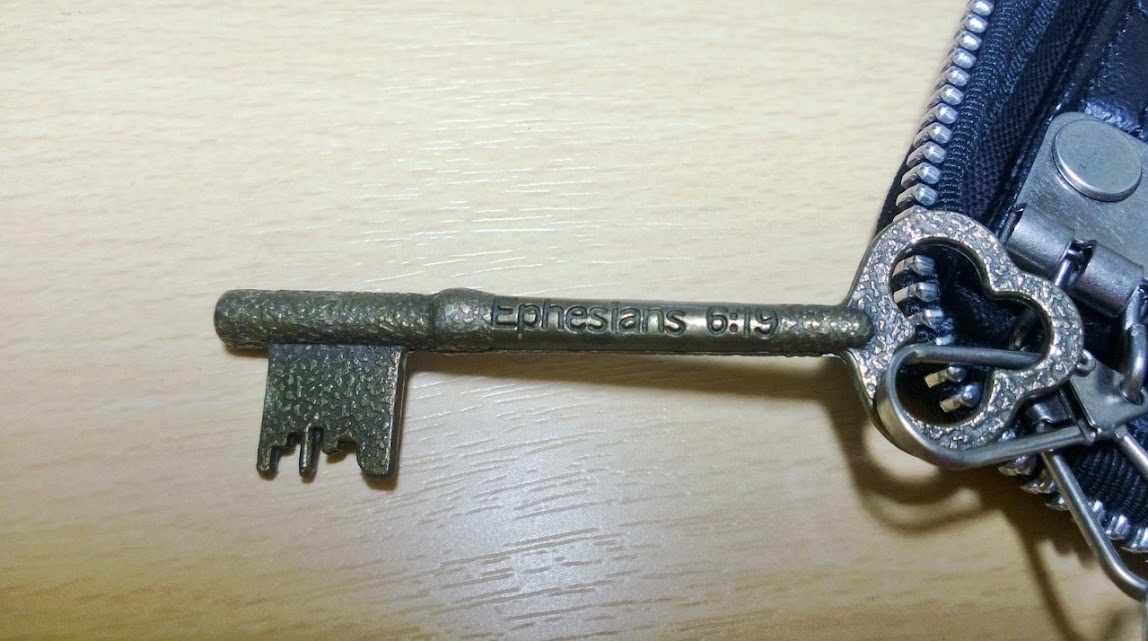
I keep it with all my other keys, so that every time I need to lock the door or use the bike, I am reminded of Ephesians 6:19 and that I have the support of everyone's prayers back home, and certainly yours :)
Related Posts Plugin for WordPress, Blogger...