Showing posts with label Prayer requests. Show all posts

Saturday, 28 December 2013

Polyphasic sleep cycle - Termination

Today is day 7 of my experimental period. At the beginning, I set myself a 10 day trial period to see how I would cope with the Uberman sleep cycle. As recorded in my logs, I had various achievements and failures, and gained some insights into sleep patterns and diet and mental and physical performance. In particular is how alert I felt over these six days compared to my expectations after reading the accounts of various others on the net who attempted this sleep cycle before me. Something that might sound slightly unusual in light of the above comments, is that I will be terminating my first attempt at the Uberman cycle as of today.

It was more out of necessity than out of my own will. Long story short, I messed up my sleeping pattern again yesterday night, so rather a matter of continuing, I have to start again.

What happened last night, even I'm not sure in detail, but here's the gist of it. After I wrote and published my previous sleep log update at midnight yesterday, I went to have my usual 30 minute nap, setting my countdown timer for 37 minutes. I'm positive that I started the timer before I went to bed, but the next thing I knew, I was awoken by my preset alarm, intended to notify me of my 8am nap… Some might doubt whether I actually pressed start on the countdown timer before I went to bed at 12am, being the reason why I failed to wake up after half an hour, but I'm pretty sure that's not it. In any case, something even curioser is that my 4am nap alarm failed to wake me up as well. In fact, I just so happened to mention in a previous post how the one advantage of the iPhone alarm system is that it doesn't stop ringing until you manually turn it off. So I know that even I didn't start my countdown timer, my preset timer to notify me that it was time for my 4am nap should have kept ringing till it woke me up. But… it didn't. And that has remained a mystery till now. Was it a bug? Is there something about how the iPhone alarm works that I'm not aware of? If anyone has any explanation to offer, I'm keen to hear it. At the end of the day, I unintentionally slept a whole eight hours last night, which makes my attempt a failure.

On that note, I'm going to take a break from this sleeping six times a day temporarily. The reason is mainly pragmatic. Tomorrow will be Sunday again, and I'm going to visit Shin-Funabashi Christ Church for the first time. What's the big deal with that? Aside from the fact that the service goes from 10:30 to 12:00 (which is when I need to be taking my nap by, which will obviously not be happening if I'm still in the church service), the pastor of the church is apparently a long-time friend of my pastor at the church I'm regularly attending, Tama Church, next to my university TUFS. I found out from him shortly before I came to my dad's. Praise God for the way the Gospel links people together! So since I have to start the sleeping routine from ground zero again anyway, it can wait a day so fellowship tomorrow doesn't get interrupted by my strict sleep routine.

Having said that, I haven't given up on trying to establish a polyphasic sleep cycle completely just yet. That's just not my style. There may be a day when I give it up, because life circumstances force me to, or because of another clear reason why. But just because I feel tired, or in this case, because of a mistake on my part that led to the failure of my experiment, is not enough for me to give up.

In fact, in these short six days, I've learned a lot from the mistakes I've made along the way. Apparently Coke was also an accidental creation, but is now regarded as black gold by many. Similarly, my mistakes that have cumulated in the termination of my first attempt at the Uberman sleep cycle, have served as a stimulus for me to retry with renewed fervour. Of course, whether my life circumstances make it practically feasible to do so is another question. Reading the sleep logs of other bloggers who tried sleeping polyphasically failed simply because their lifestyle wasn't forgiving enough to give them a chance to do the transition. For the time being, I still have a bit of time left before the new semester begins. While it's still holidays, I still have a chance to get used to it, so I'm going for it. I can't live with myself if I didn't keep trying until I could honestly say I followed my intended course and legitimately failed. Specially not when progress in these past six days have hinted at so much promise.

So it's a goodbye from me for now, but not forever. Be on the lookout for my attempt at the Uberman sleep cycle, take 2.

Sunday, 15 December 2013

Apologetics seminar in Japan

Yesterday, I was invited by a Thai friend from the same program as me, to attend an apologetics seminar held at Fuchu Calvary Chapel. It was delivered by a special guest from Hawaii with an Okinawan name and lineage called Pat (sorry, I forgot his last name >.<). He was apparently well versed in the area of apologetics, and the title he earned was proved true by what he taught today. Coming from Australia, it wasn't the first time I'd heard or read these things, but since coming to Japan, it has been my first time. Having already been 9 months, it was a welcome refresher for my faith also, being reminded that it's by faith we are saved, and that the faith we have in Christ is sure faith. I thought I would share here what I learned, for everyone's edification.

Historical reliability of the gospels
Jesus' ministry is commonly held to have taken place between 30-33AD. Some skeptics assert that the gospels do not represent the oldest record of Jesus Christ, but that they were written after the lifetime of the eyewitnesses. The implications are that they are not eyewitness accounts, but mostly legends and mythology.

According to historians, it takes 120 years after a major event for legends and myths to develop. That is because all the eyewitnesses must die first. However, if the accounts were written in the lifetime of the eyewitnesses, they are not legend or myth, but actual records of what happened. That's because the eyewitnesses can affirm or deny the things that have been written down. Made up accounts of what happened wouldn't last very long once the eyewitnesses found them.

The earliest biography of Siddhārtha Gautama, commonly known as the Buddha, comes 400 years after his life. That means much of what is written about Buddha is actually based on legends and mythology. And many people think the same way about the gospels.

What is worth noting, is that we have strong evidence that the gospels were in fact written by eyewitnesses. That means these accounts are not legends or myths; they are true stories.

Dating of the gospels
  • William F Albright, a Jewish non-Christian dean of archaeology, concluded that every book of the New Testament was written by a baptized Jew between AD40-80.
  • Bishop John Robinson, a liberal critic and founder of the "Death of God" movement, changed his position on the date of the gospels at the end of his life, newly asserting that the gospels of Matthew, Mark, Luke and John were likely all written between 40-65AD.
  • Traditionally, the gospels are dated as follows:
    • Mark, 60AD
    • Matthew & Luke, 70AD
    • John, 70/90AD

Date of the gospels: internal evidence
  • In all four gospels, Jesus predicts the destruction of the temple (occurred 70AD) but its fulfilment is not mentioned once. This was the most important building in the history of Israel, and its absence in the accounts suggests the books' completion prior to the event.
  • We know Paul was killed by Emperor Nero in 64AD, so his letters have all been written prior to that time.
  • Paul quotes the gospel of Luke (1Ti 5:18), meaning the gospel of Luke was completed before Paul died.
  • Acts never mentions the Jewish War (66AD), when the nation of Israel was completely dismantled.
  • Acts never mentions the death of the three most important early church leaders, showing that Luke completed the book of Acts before 62AD

Date of the gospels: external evidence
  • There have been over 5000 Ancient Greek manuscripts discovered to date
  • The Rylands papyri found in Egypt, dated 120AD, contains a fragment of John. To reach Egypt by that time, it must have been written much earlier.
  • Clement of Rome 90AD and Ignatius 107AD quote many of the books of the New Testament as Scripture
  • Polycarp 120AD, disciple of John, informs us by his writings that the canon we have today had already been confirmed in his time

Archaeology and the gospels
  • Luke names 34 countries, 54 cities and 9 islands very accurately
  • He also mentions the names of government officials, whose names sounded very strange for people of that time, but recent archaeological evidence affirms all of their existence
  • William Ramsey spent many years in Israel trying to prove Acts was unhistorical, but at the end of his studies, he highly appraised the calibre of Luke's writing, and became a Christian
  • John mentions the pool of Bethesda in his gospel, and we have discovered this pool recently in israel

The historicity of Jesus
His existence is recorded in secular history records, both Jewish and Roman. The notable thing is, these people were enemies of Christianity historically. By their acknowledgement that such things took place, the enemies of Christianity affirmed the accuracy of the gospels.

The Jewish Talmud (completed 300AD) speaks of a historical Jesus and tries to explain Jesus' miracles by attributing them to sorcery and magic. What is interesting, is that by not denying these phenomenon, it affirms that they really took place. Also recorded is Jesus' crucifixion, and the death of five apostles. Thallus mentions in his third book that the earth covered by darkness when Jesus was crucified. Tacitus (115AD) through calling Christians evil by documenting all that they were doing, affirms that the events and the people of the NT were real.

In court today, if your enemy affirms your story, that is the most powerful evidence.

Q&A Session
Using the conclusion we established in the first session, namely the historical reliability of the gospels, we proceeded to answer mostly prepared, and some impromptu, questions on the topic of apologetics.

  1. Why do Christians do wars?
The use of force is necessary to keep the peace. In the book of Revelation, it is written that Jesus will one day return and wage war against evil. If the Son of God must use force to defeat evil and bring peace, so must we.

At the same time, the Bible gives guidelines on when and how to use force. Violence must be as a last resort, and even then, only proportional means to win, and not to decimate the country, and the civilians must be spared.

Some people use Matthew 5:38-42 to argue that Jesus preached pacifism, by insisting that one must not lash back against a wicked man. However, this teaching does not prohibit the use of violence. In Jewish times, a slap on the right cheek means "I despise you", in this case, for being a Christian. So the passage actually says that if you are despised for being a Christian, don't fight back, turn the other cheek instead. It does not prohibit the use of force to stop someone who is defenseless from being harmed.

However, the Bible does not endorse murdering people who are not Christians. Sadly, this has happened in history. That is man's fault, it is directly in contrary to God's commands, and it should never have happened.

  1. Doesn't a monotheistic belief cause people to be narrow minded and intolerant?
This question strikes close to the heart of the Japanese people, who believe a polytheistic belief is more welcoming and less exclusive.

Firstly, it is correct to say that a monotheistic belief is narrow and exclusive - because that is the nature of truth. Truth by its very nature is narrow and exclusive. It excludes all other possibilities, by calling them fallacy. So it can be said that anyone who believes the truth is narrow minded and intolerant of what is not truth.

Accordingly, when the Bible teaches that Jesus is the Son of God, any religion that denies that is wrong. And if Jesus is the Son of God, and he taught that he is the only way to life, then every other way to God is wrong.

  1. I can believe in God, but I can't accept why I need to believe in Jesus.
The bible teaches that God has given us the perfect law, and put it in our hearts. Romans 2 says that Christians and non-Christians alike have the moral law within them. Everyone knows we have not lived perfectly according to God's law, and that makes us all sinners.

Someone needs to die for sin, but no one except God is perfect enough to be able to. However, God cannot die. So Jesus came to earth as a man, in order to become the perfect sacrifice for sin, and to die the death we deserve in our place to pay the price. No other religion can offer that, and that is why we need to believe in Jesus.

  1. Why do people suffer if there is a just and loving God?
If God doesn't exist, life is ultimately without meaning and without purpose, and your suffering means nothing. But because God exists, our life has meaning and purpose.

James 1:2 tells us to endure trials of various kinds with joy, because it builds our character to be more like Christ. In the Hebrews 5:8, it says Christ learned obedience through suffering, so we should expect to go through the same thing.

Some skeptics ask question of why children who are born crippled have to suffer and live meaningless lives. But how do you know they live meaningless lives? Some of the greatest lessons we have ever learned come from people who have suffered tremendously. Nagai Takashi from Nagasaki who suffered radiation position from the bomb and was paralysed for much of his life, but through his suffering he wrote several inspirational books that are read all over the world. Furthermore, Christians look forward to that day when Jesus comes back, because there will be no more suffering.

On the other hand, what message does an atheist have to give to these crippled people? They offer no substance, no hope, and no meaning, not just for cripples, but for anyone. Just suffer in a meaningless life, die and disappear.

How do we know the Christian gospel is truth, and not just a fairy tale? Because our faith is based on a real Jesus who really rose from the dead. Only Christianity can offer any message of hope for those who suffer.

  1. What will happen to someone who dies without ever hearing the gospel?
This is possibly the most difficult answer for Japanese people to hear. It is not an easy answer to stomach, but sometimes truth is just that.

Romans 1:19-23 says every passing day points to a creator, from the telescope to the microscope. How much more complex is the human brain than a computer, which no one would ever believe came about sponaneously or accidentally?

Romans 2:12-16 says that everyone has the witness of God through their conscience, and we all know right from wrong. For example, murder, adultery, and stealing are universal sins unanimously considered to be damaging to society. The biggest sin of all, is denying the creator God who made us and gives us purpose in life. And for those who don't believe in Jesus and accept his death on the cross for their sin, they will be condemned to hell.

Having said that, Acts 10 mentions a God fearing Roman soldier named Cornelius who didn't know Jesus but wanted to know God. In the end, God used Peter to share the gospel with him, and he believed. Whoever wants to know God, God will somehow get the message to them.

Hebrews 9:27 tells us that there are no more chances to repent and believe in Jesus after you die.

  1. I have mounting doubts even after say I believe. Does my faith need to be reevaluated?
Doubts are actually a good thing!

"The unexamined life is not worth living." - Socrates

For us Christians, the unexamined faith is not worth living.
God is big enough to answer any questions we have concerning him. Other religions say don't ask, just believe, but Jesus and the apostles invited others to ask questions and seek answers. So when you have questions, it should motivate you to seek answers! Many Christians who do not ask questions about their faith, are those who fall away when their faith is challenged.

  1. Why are there so many divisions within Christianity like Catholicism and Protestantism? Which one is right?
Truth is measured by the Bible, not by man-made parameters. We measure whether a church or a denomination is consistent by the Bible. The Bible, God's truth, is never wrong, but human interpretation is not perfect (1Corinthians 13:12, this world is like seeing through a mirror unclearly).

We do not have perfect interpretations so we do not have perfect understanding. But we should agree on the essentials such as there is one God, the Trinity, and the Son of God Jesus Christ. On the non essentials, denominations are allowed to disagree like how to conduct baptism.

As for Protestantism and Catholicism, the former initially came about as a result of the latter drifting away from Biblical teaching. If you read up on Martin Luther (not Martin Luther King) in the 16th century, you will learn why. I didn't bother writing down what's already on Wikipedia.

  1. How do people who lived and died before Jesus came to earth get saved?
Just believing in God through our knowledge of the creation and our conscience (Q5) is not enough. We need special revelation to know God, and that special revelation came through the nation of Israel.

Israel had the system of offering sacrifices for sin. That sacrifice was an unblemished lamb that would shed its blood for the sins of the people. The lamb itself did not save people from sin, but it was a prophetic symbol of the Saviour whom people would put their faith in.

Foreigners outside of Israel still had a chance to hear the gospel. Many came to Israel to learn about God. In other cases such as Jonah, God sent a prophet from Israel to reveal himself to the foreign countries.

  1. What age of children are saved?
The Bible talks about an "age of accountability". After a certain age, children are able to understand and respond to God's expectations. In Israel, the Bar Mitzvah ritual takes place at 12 years of age, but that is more tradition and not something taught in the Bible. The bible doesn't specify when exactly the "age of accountability" is. The actual timing may depend person to person.

  1. Will a spiritual revival come to Japan?
400 years ago, Christianity thrived in Japan (Edo period). As we study the lives of the Christians back then, they were faithful to Christ, enduring persecution and even dying in his name.

An age of revival may not have yet come, but before one will come, God's people must be faithful to God's call in the Bible. Revival begins in God's household. Let's pray for revival to sweep Japan, and pray that it would begin within.

Autumn semester: Complete

Sorry for the long period of nonresponsiveness! As of this week, exams are over, results have been returned, and holidays begin!

It's been no short of hectic this semester, since the results from this semester and this semester only get sent to our prospective universities. Everyone has been studying the hardest they've been to date, and arguably, the hardest they ever will this entire academic year. There is a final winter semester left beginning in January before we graduate, but we need no more than a passing grade, regardless of which university we are aiming for next year, so I'm anticipating a lot less studying and a lot more enjoying from here. 

Exam schedule for end of semester exams

There was a weekend in the middle of our four day exam period. We were so grateful for it! - till the details of which exams took place when came out. Literally ALL of the time consuming subjects were held before the weekend, while those that took only a fraction of the effort to study for were after it. At the time, everyone was like, I don't even…!
Later I realised that the exams that take the longest for us to write, also take the longest for the teachers to mark. And all of the exams were scheduled to be marked and returned to us the day after exam period was over. Since the exams containing the most content would also take the longest time for the teachers to mark, it made sense that they were given the weekend to have more time. I can sympathise with the teachers here in Japan who operate under such high pressure.

So in continuation of recording my results for future record, and sharing them with those back in Oz:
Kanji writing/reading
99
Japanese grammar
99
Japanese reading
92
Japanese listening
100
Japanese speaking
90
Japanese composition
88
Politicoeconomics
8586
Japanese history
100
Japanese studies
90.4

Not even worth mentioning is how the marking scheme for the politicoeconomics exam has once again been altered post-exam. Should I mention that this time, he also modified the exam itself, halfway through the exam? The topics we learned about this semester were identical to those covered by Japanese high school students - or at least we would have learned them, if we'd actually been taught it properly. Why couldn't he use an established textbook to structure the syllabus and learning content instead of talking about something completely irrelevant to the handouts he gives us each lesson and then expects us to retain both the handout content and what he was talking about? This is the only exam for which I stayed up beyond my normal bedtime, three days in a row, before the exam itself. And it still ends up as my lowest scoring subject. Enough venting from previous posts, so I'll leave it here.

I might mention here that there is negligible difference in final university preferences between getting a 90 and getting a 100. The grading system used by the school here is that 90 and above equates to an "S", 80-89 is an "A", 70-79 is "B", 60-69 is "C", and below 60 is fail. So ultimately, that means the two 100 mark subjects aren't anything special, and instead, for two subjects I failed to get an S grading. According to the teachers, I lose my chances of getting into Tokyo University, since their minimum expectation is apparently an S grading for all subjects.
I'm not disappointed or anything by that, since at least most of the universities in Japan have a high standard of education. If anything, it saves me the temptation of boasting in my own ability by starting to think I did it all by myself, and forgetting God's grace and His sovereignty. I do admit that whenever I contemplated studying at TokyoU these past few months, it only ever fed into my pride, which is already a major spiritual struggle to deal with. I'd appreciate your prayers for an awareness of how I as a sinner have nothing to boast about before God, and to remember how I depend upon the grace of Christ poured out on the cross for my sin.


Sorry for my long absence from my blog, and thanks for all your prayers through that time guys :)

Sunday, 10 November 2013

Meeting an Australian Senpai from Tokyo University

Yesterday I met for the first time with an Australian who came to Japan on the same program as me back in 2004. This has actually been the second Australian senpai I've met since coming to Japan, but due to my unfamiliarity with blogging at the earlier instance, I neglected to say something about it here. The first senpai completed her undergrad studies at TUFS beginning of this year, whilst the one I met yesterday graduated from 東大, aka, Tokyo U. And they're both really friendly and helpful people.

In Japan, you refer to people who have gone down the same path before you, "senpai". The one who comes after, is referred to as "kohai". Objectively, these distinguishing terms are just there to indicate who has been around for longer, subsequently having more experience and usually (but not always), age. Even in Australia there are peer support and mentoring programs to connect newbies wih senpais in schools and universities and such, but Japan makes a particularly big deal out of it. Unlike things like peer support and mentoring which only go on for a year or so, the senpai-kohai relationship between two given Japanese people, is forever, or so I hear. The implications are interesting. Say there's a third year male uni student and second year female uni student in a given sporting club. Irrespective of gender, the second year student would continue to use polite form Japanese when communicating with the third year whilst the third year student would use casual language in response, and they'll continue to do so for as many years as they remain in the same club. Even if they start going out, the politeness levels won't change. It's not surprising to see this difference in status, reflected in their communication style, carry on into marriage.

As a related story, one of our teachers told us about two girls she met who grew up in the same city, and had always been in the same class, and were really good friends. However, somewhere down the track, one of the girls ended up starting university one year earlier, though they ended up in the same university, making her a senpai to her long-time friend. That caused them considerable difficulty, since even though they were such close friends, societal expectations expected them to observe their status difference in the language they used. Apparently the train they used to commute to university crossed a large river, which marked the boundary between two cities. The two girls agreed that once the train crossed the river, they would become senpai and kohai, and when they crossed it again to come back home, they would be normal friends again. Only in Japan.

My Australian senpais and I are all aware of that Japanese custom, but at the same time, we're foreigners so it's ok to talk as friends anyway. Not to mention, English lacks the function to express different levels of politeness that Japanese has so it's frankly quite impossible to communicate such status differences through conversation anyway. Having said that, they still shout me lunch/dinner since I'm their kohai :D

Anyway, to pick up where I left off, I arranged to meet with the Tokyo U senpai yesterday to find out more about what it was like to study there. She just so happened to have a Malaysian friend who came on the same program in the same year as her and graduated with a degree in education from Tokyo U, so she kindly brought her along as well.

Tokyo U has multiple campuses around Tokyo. All students in the undergrad program are required to do their first two years of study at the Komaba campus, and during this time, to take a variety of subjects from both science and arts faculties, irrespective of their major. After that, they do proper study for their major over the next two years at their respective campus, which is the Hongo campus for an education major.

Tokyo U has numerous dorm facilities, but according to my senpai, students from our program are only offered the Mitaka dormitories which aren't exactly close to any of the campuses. Apparently it's like a haunted house… I guess I'll have to wait to find out what that means. Though on the bright side, the rent is 1万円, or about AUD$100, per month. To compare, our current dorm rent is 2万2千円 (~AUD$220) per month. Dirt cheap, specially considering it's Tokyo.

I was advised to research into the professors in the Education department well, because I'll need to ask one of them to be my supervisor for the latter two years of study.


Something I was informed about Tokyo U a short while back is regarding their Christian group. Apparently there are a lot of non-Christians in the Japanese Bible study at Tokyo U, praise God! It's been keeping the leaders busy. The flipside, however, is that they've been kept from starting and maintaining an English Bible study group. If I do end up getting into Tokyo U, I figure I may as well be in an opportune position to start one. In the meantime, your prayers for direction for next year would be highly valued. God bless :)

Wednesday, 9 October 2013

Another half semester down!

I am so happy that mid semester exams are over now that I wonder whether my feelings can be communicated through my words. Bit by bit, my quiet time with God has shallowed in time and quality. This semester has become hectic to the point where I don’t even have time to reply to my email messages. In other words, happenings in my local world are such that it leaves no room for the digital world, so apologies for my absence from my blog. Having said all that, I am nevertheless thankful to God for the fulfilling local world experience that have eventuated. And at the least, God has granted us Christians from this program to continue meeting weekly to read His word and to pray together without interruption. We met up again today, in fact, and it was a time of encouragement.

In the big scheme of things, many, if not all the students in my program are struggling with fitting everything into the time frame we are given. It hasn’t all come unexpectedly, as have been warned about this autumn semester. It appears that this semester's results, and only this semester's results, are submitted to our prospective university. That means two main things. One, this semester's results are incomparably more important than both the previous semester and the next one. Two, our cohort has suddenly become competitors, not friends.

Well ok, on the last comment, to be accurate it's not exactly everyone competing against everyone. If two people want to study the same major at the same university, there's competition, but if not, then it's ok, they can remain your friend. Having said that, there are about 15 people in economics and most of them want the best university possible. I'm glad there isn't that sort of competition for education. As of the moment I know of one other person, and our preferential universities are from different regions.

Anyway, to pick it up where I left off, we just completed our mid semesters:


Friday 10/4 Politicoeconomics (why is it always first??)

Monday 10/7 Kanji reading/writing
                          Japanese history
Tuesday  10/8 Japanese grammar
                          Japanese listening
Wednesday 10/9 (Today) Japanese reading and comprehension

And best part of all, Thursday and Friday (10/9-10): Excursion! :D We are going to Nagano city and Matsumoto city in Nagano Prefecture by bus with our entire cohort, four teachers and 11 Japanese students. We'll be leaving early tomorrow so gotta sleep early :P

But for the moment, a few comments on why the semester has been so busy. First is politicoeconomics. I have vented enough already so I will refrain from repeating myself, but I will say that I spent at least 5 times more in both time and effort for this one subject than any other over the final week leading up to exams. And I wasn't the only one who lost sleep over this subject. It wasn't because it was particularly difficult, since Japanese history (and getting high marks in Japanese) was about as difficult, but the completely disorganised structure of the subject combined with the increased expectation that comes with having progressed half a semester further meant that we didn't quite know what, or how, we were supposed to revise. As a result, our study efficiency was reduced, and thus the increased labour. I am pretty sure it is still going to be my lowest scoring subject nevertheless.

History, as well as the other Japanese tests, were structured quite similarly (which meant structured predictably) to the previous semester, so it was overall fine. Just put in the hours, and the marks will come. It was indeed straightforward, but some may view it as too artificially academic. Majority information recall questions and negligible idea synthesis questions means we aren't examined on whether we truly understand the information. But considering where we are at with our studies here, I think it's an appropriate means of solidifying our foundations at the very least, for tertiary level thinking when we enter university. Not to mention it standardises the grading for university selection next year. The above reasoning applies in the reverse to politicoeconomics, as it should have been made apparent.


Our results will come early next week, when I'll post them up just like my previous ones. Till then, Nagano, here we come :D But first some sleep.

Saturday, 31 August 2013

Japanese Christian events in the summer vacation

So I've been surprised to find out that once summer vacation begins, Japanese Christians become this active. Here's a snapshot of Christian happenings in the next half-month or so. Please pray that God would change lives this summer.

August 20-23: Challenge Camp.
60 students gather to be challenged to serve and to personally evangelise.

August 24: Evangelistic Bible study with Japanese contacts from Sydney.
Pray for soft hearts towards Jesus and good conversations at local fireworks afterwards.

August 27-30: Summer School.
90 students gather to hear how God "likes" them (Facebook reference).
Praying for Yoichi from Chuo University to be saved, and for 10+ others who don’t yet know Jesus.

September 3: Excursion to trick art museum with the Tama area Christians.
Pray for good relationships that will flow into our monthly prayer gatherings for campuses in the Tama area.

September 9-11: Chuo University camp.
In addition to the Christians who will be in attendance, continue to pray for Yoichi.

September 13-14: Block leaders camp.
Pray that the leaders will refreshed to serve in Semester 2, which will begin in the following month.

The above prayer requests are actually from Naomi Smith, an Australian whom I first met at a Japanese church in Sydney and is currently a staff worker with Japanese university Christian group KGK. The most notable point is, we both came from Sydney to Japan around the same time, we are both here for God's mission, and we are both in the same area! I am honoured to support her in prayer as she gets busy on field in this time. She will be giving numerous talks, seminars and training sessions. I hope you'll join me in supporting her too :)


I won't be directly involved in any events like these this summer vacation. One because I kind of overbooked this vacation before I knew it, and two because I'm not formally a university student yet. But looking forward to getting involved next year! Pray I will be an encouragement within the Christian community.

Friday, 26 July 2013

Start of summer holidays! Time to - get busy…?

It's been one week since end of exams, and one week into the summer holidays - and boy has the past week been busy. Before I realised it, it's approaching the end of the month, and I've only written one blog post (excluding this one) during this time. And that's not about to change (the busyness, and not the sporadic posting, hopefully) as the summer holidays progresses, and here's why.

----------------------------------------
20 July - Holidays began

26 July - Today
27/7~5/8 - Shizuoka homestay program (where Mt Fuji is)
6/8 - Day out with KGK Christians at Tama Church
10/8~12/8 - Driving around Tokyo with Dad

18/8~25/8 - PTC exam period
21/8~28/8 - "Japan Tent" International Exchange in Ishikawa Prefecture

2/9 - Second (autumn) school term commences
----------------------------------------

Phew. Even contemplating such a plan overwhelms me. As you may have noticed, the Japan Tent trip and the PTC exam period overlap. Which is a problem, since the pastor from Tama church and I had previously arranged to have the exam set on 24th August. That's a bit of a problem. The problem is that I was only notified by the Japan Tent people yesterday that I was accepted, so I couldn't factor that into my summer planning. I always have the option of moving my exam earlier, and being able to attend the Japan Tent, but it depends upon the pastor's availability and even then, I will have virtually no time left to do my summer homework (which I haven't started). Please pray for wisdom in how to navigate this decision, what to keep and what to sacrifice.**Update, I have withdrawn from Japan Tent, to opt for more study time for the PTC.


A shout out to those back in Australia who came back from MYC and AnCon respectively! I can see on Facebook that it was an edifying time of delving into God's Word and fellowshipping with one another. I hope to join you guys same time next year when I come back to visit during my holidays :)

Sunday, 5 May 2013

Visiting Musashi Sakai Red Cross Hospital

First of all, a big public thanks to everyone who has been praying for me. I can attest that your prayers have made a difference, and been a huge encouragement to me. I know that God has been good in answering prayers I've requested, but also prayers I've prayed for others. I was informed by +Michael Tong in our google hangout last night that a non-Christian who visited our church back in Australia whilst I was still there, has attended on numerous occasions, as I prayed that he might. But again to exceed my expectations (and everyone at church, it seems), he has been reading the Bible at home of his own initiative! Praise God. Aren't I concerned he might see this post? I think it would be a good thing for him to know people have been praying for him!
And I don't know if it was because you prayed that I'd get better, +George Mason, but your prayer has been answered, haha. As I promised in an earlier post, I'm documenting the outcome of the specialist visit last week Friday. Apologies for the time delay; it's been a full on week. Also, happy golden week everyone!


I didn't understand everything that was going on, because my Japanese is still limited, but as far as I could ascertain, there were no GPs in this hospital. Since every person who goes to the hospital has at least some idea of what abnormal condition they have, from the beginning you ask for a doctor specialising in the field you want further examination in. For example, I was referred to the respiratory specialists ward. I also saw a neurological ward and a pathological ward. I suppose if you somehow caught three different types of illnesses simultaneously, it's up to you to go to each respective ward for the check-up.

The next thing I was surprised about was how young the doctor who I consulted was. He was a respiratory specialist no doubt, but he looked younger than 30 - although I have noticed that Asians generally look younger than their actual age. So anyway, his diagnosis was the same as the doctor at the university, 咳喘息. No photo of the doctor either. Asking the doctor for a photo would be quite strange.

What was also strange was the design of the medicine, although "different" might be a better description than "strange". Can you guess what the purple thing is used for?


On right left are tablets, but they are seriously tiny. Each tablet was the size of a pimple (ok maybe a fairly big pimple). They are certainly easy to take. I don't know what the proper English name would be for the contraption on the left (in fact don't know what it's called in any language) but it's like an inhalant. You can slide the tab on the spine of the container to expose a mouth that dispenses medicine in powdered form, which you inhale.

What also surprised me, for the worse, was the medical bill. Just a note that the exchange rate is approximately 1AUD = 100JPY.


It might be normal to expect $300 for a specialist consultation, but due to both my limited experience with medical bills and my stingy student perspective on money, it sounds like a lot to me. Even with the health insurance card that all students in Japan are offered, after a 70% discount I still had to fork out $90 for one appointment. The most annoying part is that the receipt doesn't tell me where the majority of my fees came from, since the consultation itself apparently cost $3. Additionally, the medicine set me back $30, also after applying the 70% health insurance discount. The moral of the story is don't get sick in Japan. Especially if you don't have health insurance.

On a different note, praise God that I managed to send out this month's prayer letter on schedule! Thanks for +Lauren Tsang's farewell present, which motivates me to continue sending out my letters on time.


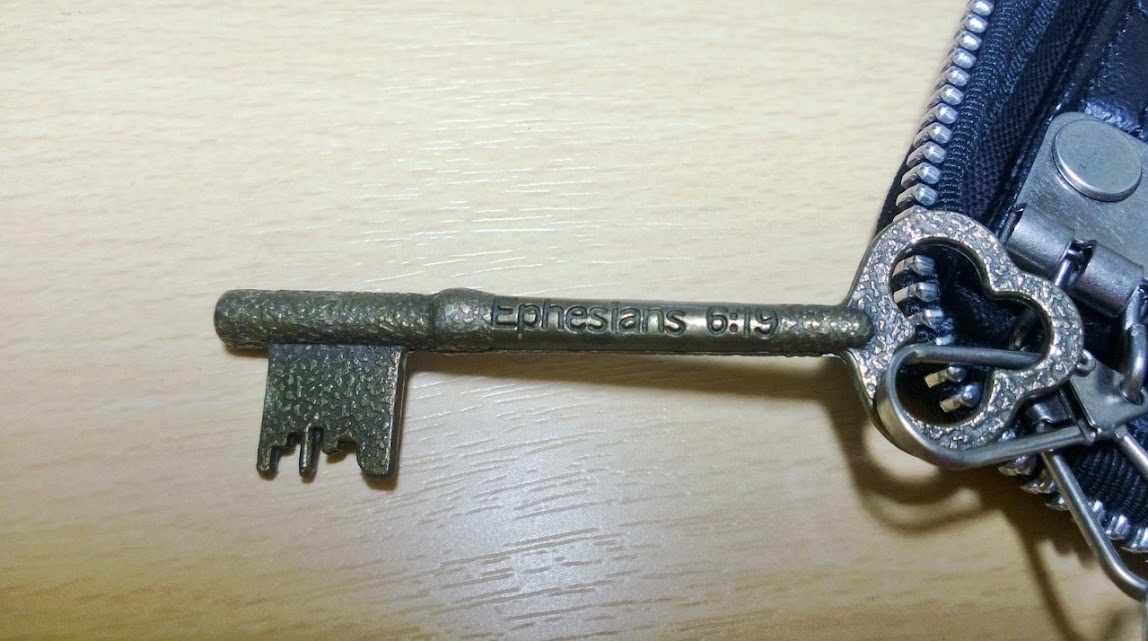
I keep it with all my other keys, so that every time I need to lock the door or use the bike, I am reminded of Ephesians 6:19 and that I have the support of everyone's prayers back home, and certainly yours :)

Tuesday, 23 April 2013

Byouki ni narimashita =.="

Two months before coming to Japan, I developed a phlegmy cough. It was of light to moderate intensity, and remained much the same throughout the whole time. Prior to coming to Japan, it appeared to go away, so I didn't think much of it. However, it's getting close to one month in Japan now, and as of last Friday, my cough got significantly worse. In other words, byouki ni narimashita.

I visited the hospital on campus yesterday afternoon to get a checkup, but the results were enigmatic. My temperature was normal at 36.5oC, the doctor didn't hear anything abnormal using the stethoscope, and the chest x-ray showed no abnormalities either. My three-month-long persistent symptoms, however, definitely say that something is wrong. The doctor could conclude that it isn't a typical cold, flu, or hayfever, but beyond that he could merely speculate. He told me that at my age, the most likely possibilities are either Tb (tuberculosis - I actually studied that for a whole semester in Australia), or sports-induced asthma (He called it 咳喘息). Why the second diagnosis? Well upon arriving here, in my best efforts to remain fit and active, three weeks ago I began jogging every morning. Unfortunately two weeks later, my symptoms aggravated. Of course, there are also other possible explanations to my worsening condition, such as change of diet (or merely not eating enough fruit & veg) or sleeping too late, but again, as of now they are merely possibilities. Truly enigmatic, though.

I've been given a reference to see a cardiologist in a neighbouring city, and I've received permission from my class teacher to be excused from class this Friday to visit. I'll give an update on my cough thing when I learn more. Until then, please don't concern too much for me, as might happen when one mentions they've had the same sickness for three months. That was merely background story to the main reason I published this post, which was to document my first visit to the hospital in Japan, on this scholarship.

These masks are very fashionable during the colder months of Japan.
That's what a foreigner might think, looking at how many people wear them on the streets. Well I get to be fashionable as well for a period of time.

I've already had Christian friends here offering to pray that I'd get better, and I appreciate their concern. Some who read this may also share similar desires, but if you are to pray for me (please do!), you don't need to pray that I might get better. In a nutshell, there are much greater things worth praying for. When we pray for things to be a certain way, we're saying that that other situation is better. We pray for love and patience, because it's better to be so, we pray for peace (both individually and globally) because it's the better way, we pray for Jesus' return because we want to be with Him in heaven, and we pray that everyone might come to know Christ and see His great love for us because that's what we were made for. Praying for better health is certainly wishing that a person's quality of life will improve, but I can't agree that being in a poor state of health is necessarily a bad thing. For one, being sick reminds us that we are physically vulnerable and fragile creatures, limited by time and space. Sickness also serves to make us grateful for good health. And even whilst sick people are commonly disadvantaged in some way against healthy people, it teaches us patience, perseverance, and empathy. For me, my persistent cough has also stood to bring me closer to God over time, in firstly being reminded that He is able to make me well whenever He would like, and that He knows better what is best for me at this given time. Not only that, it also makes me thankful toward God for meeting my greatest need for healing through Christ, for my sin to be forgiven and my relationship with Him restored, as Christ came to Earth to accomplish (Lk 5:31-32). In my sickness, pray not merely that I might get better, but that in my time of weakness, that Christ's strength would be seen and Jesus' name be glorified (2Co 12:9).


On the topic of making God a priority in my life, I have set aside half an hour to one hour each morning for quiet time with God. Each day of the week I base my prayers off a certain theme, from personal to mission to my church, etc., and learn to read the Bible in Japanese a bit at a time. I'm only four chapters into Matthew, and I've already accumulated 108 words (most of them in new kanji) in my list of new Bible vocabulary. I have motivation to keep going, though, because even just comparing my experience of church here on the first Sunday and the second Sunday, through my personal Bible reading the number of words I could understand in the worship songs and the sermon was markedly different. Pray that I'd persevere in the difficulty of learning to read the Bible in a new language, reminded of the reward that I will reap in being able to understand and articulate the gospel in Japanese. I've had many opportunities to have gospel conversations in Japanese over the past three weeks already (praise God!), both with local Japanese people as well as fellow scholarship recipients whose Japanese language ability surpasses mine, but undoubtedly it's still a huge struggle to communicate ideas, when my fellow conversants don't speak English well, so pray that as I gain better Japanese ability, that I'd be able to utilise it in conversation well. じゃ、またね!

Friday, 19 April 2013

Christians at TUFS

Sorry for the delay between my previous post and this one; it's surprising how busy my week has been. To continue where I left off in my last post, we gave (quite numerous) self-introductions (自己紹介) last week in class. Firstly, the basic name-country-areaofstudy. On another occasion, a written version of around 800 characters long in the form of our first writing task. Yet another time, we gave introductions - this time of someone else in the class - and we took turns presenting what we learned about the other person in front of the class as a listening comprehension exercise. We did so many types of self- and others-introductions, that our final teacher last week (five of them take turns teaching us each week) ran out of different methods to introduce ourselves.

If this post was merely me venting about how many times I had to mention I was from Australia last week, it would be about as interesting as sitting through all our class self-introductions (that is, somewhat interesting). However, what makes this post worth writing, is one particular introduction given by another Christian in my class.

I was asked quite early on to introduce myself, and I gave the usual country-subject-family-hobby-etc.; stuff which you'd usually expect first time round. After all, everyone else in the class followed the same pattern - everyone else, except one Ukranian girl. Before she gave her self-introduction, I had no idea she was a Christian (whilst she had no idea that I was also, even after I introduced myself). Her level of Japanese at the time was a long way off from proficient, but even as she struggled to express herself in a language yet foreign to her, she was determined to let the class know that Jesus was the most important person in her life. Not surprisingly, the teacher evaded the topic altogether, choosing not to inquire further about her belief despite asking further questions on everything else she mentioned in her self-introduction. But I was certainly humbled and encouraged at the same time, from realising that it didn't even occur to me to mention my faith when introducing myself for the first time, whilst for her it was such a natural thing to openly voice the value of her faith.

Even though I've been studying Japanese for six years and been a Christian for many more, only last week did I realise that it has not occurred to me even once in that time to mention I was a Christian in a self-introduction. All I've been absorbed in was how to make my speech funny, how to make it unique, what would help people remember me, when all along I neglected to mention what was most important to me! Yes, it's true that it probably never naturally occurred to any (or at least most) of my fellow foreign language learning friends back in Australia to mention their faith either, but I wonder if we should consider that acceptable. Does it reflect our new identity in Christ (2Co 5:17)? Does it reflect the value of our faith (1Pe 1:7)? Do others see a person changed by the knowledge of Jesus Christ (2Pe 1:3)? I was so absorbed in figuring out what made me stand out that I overlooked my most basic characteristic - my identity in Christ. Thanks be to God for first answering my prayers made in Australia to bring Christians into my life. When I prayed that, I did not expect to meet another Christian in a class of 8 people, but it goes to show that God indeed looks after His people (Rom 8:28).

The answer to my prayers doesn't end there! Speaking of God exceeding our expectations, the Ukranian girl I met in my class was one out of many Christians I subsequently met. In our Monbukagakusho scholarship cohort of less than 60 people, so far I've met (aside from the Ukranian girl) two Christians from Bulgaria, two from Thailand, two from Singapore, and one (so far) from Korea. That's over 10%, in comparison to Japan's national Christian population of less than 1%! Praise God!

With the number of Christians on the campus I'll be studying at this year, we could plant our own local church. But praise again goes to God, because we don't need to - there are already two churches in our locale - Tama Church, in the photo below, named after our suburb, and Fuchu Calvary Gospel church. I've attended the former for the past two Sundays, and in that time I've learned that they teach reformed Protestant theology; in other words, the church service style and preaching are just like ALLC - only that it's conducted in Japanese. The latter, however, is an English-speaking church, which I found out about from the two Singaporean Christians who attended it on the first Sunday. I've been told by those who have attended their service that their style of service is more "contemporary", though I can't comment beyond that since I haven't been there (which is also why I haven't taken a photo). I'm more than content with regularly attending Tama Church so far though. God is good.


Having said that I've met so many Christians, the only thing I'm certain of is that they have been Christian up until this point. Upon first impression they are all amazingly eager to continue growing in their faith and staying in touch with the Christian community in Japan, for which praise goes to God, but time will tell how this culture shift will affect our Christian faith. Speaking for myself, I've been faced with many temptations already during my time here of a different nature to that which I had to deal with back in Australia which have tested my faith and love for Christ, and I can't say it's been easy. One thing I haven't been mistaken about prior to coming to Japan was that I can't take my faith in Christ for granted here. If it weren't for the prayers of all those back in Australia, and God's grace made effective in my life through all your prayers, I wouldn't last long at all. So thank you to those who have been praying for me, and special thanks to +Jas Lau for this elephant candle, to remind me to never forget, as an elephant never forgets, that there are people praying for me back home, and also to remind me that God has made me a light to shine in the darkness (Php 2:13-16). Thanks also to others who have given me small gifts of memorabilia to remember both my family of God back in Australia, as well as the God who unites and sustain us; I will showcase them over the weeks to come.


Sunday, 31 March 2013

So this is goodbye…


It's been a dazed past 30 days in my preparation for departure, since my farewell events. Apologies to those who saw me again after coming to my farewell event. Awks. From the bottom of my heart, though, a big thanks to those who came all the way to Asquith to say goodbye in person. It meant a lot to me, seeing how much I meant to you. A special, public expression of thanks to those who went to great lengths to make it to my farewell event - driving one and a half hours, public transport for one and a half hours, and coming straight from work, so that they could say goodbye in person.

Special mention goes to my pastor at ALLC for the care he showed, which went well beyond merely his duty as a pastor, to supporting me as a friend and a fellow brother in Christ.

Special thanks to my mum for doing what she does best, which is look after me whilst I was under her care. You've cooked for me, cleaned for me, and taken care of me when I got sick, and you only ever increased the attention you gave to me as our time together physically grew short.

Last but not least, thanks and praise be to God who has shown His love for me, both for His single act of redemption for all Christians by sending Jesus, and for His ongoing work personally in my life to shape my thinking, speech, and actions through the gospel. I thank Him for how smoothly my farewell parties went, and opportunities to farewell well. I thank God also for the privilege of doing ministry in my remaining time in Australia, at university and in my neighbourhood. I also thank Him for answering former prayer points on my blog already - connecting me with fellow Christians to meet with regularly in Japan! More on that in a future post. It also means my prayer answered regarding finding a church, as I will be able to join the church that these Christians currently attend.

In my pre-departure, pray first of all that I might maintain a regular quiet time that I can spend on my own in prayer and in God's word. I also pray God would lead me to a faithful Bible-teaching church, because biblical resources and teaching are far more scarce than Australia. Pray for time management also, as I juggle meeting new people, staying on top of homework, keeping in touch with family as well as friends back home, and my personal devotional time. And pray I would be able to keep up with sending monthly prayer newsletters for those who are praying for me! If you would like to support me in prayer during my time in Australia, you can sign up at http://eepurl.com/u0Q8b.

Sydney, Australia, goodbye! Tokyo, Japan, here I come :)

Saturday, 9 March 2013

Preliminary Theological Certificate


Yesterday, I opened a parcel to find this:

 Photo

After hearing about - and from - quite a number of friends having started it, and being given a personal recommendation from a teacher from my high school who’s completed all 18 units, I've finally gotten around to enrolling myself. I'm talking about Moore College's Preliminary Theological Certificate.

Some Christians I'm really grateful for in my life have been asking me what ways I intend to keep growing as a Christian while I'm in Japan, where Bible teaching will no doubt be hard to come by, let alone of a quality as we take it for granted here in Sydney. Well, Moore College is one of the two solid, faithful Bible colleges I've been considering for my theological degree, so completing this program offered by them will be like starting Bible college early. Working through all the units of the PTC is one way I intend to challenge myself in my faith during my time in Japan, along with listening to weekly talks from CBS and my church.

For those who haven't heard of the PTC course, I couldn't recommend it any higher. It gives you an excellent foundation in reading the Bible well, in the correct context of the book of the Bible it came from, the whole Bible, and in the backdrop of church history. Until I actually spend some time getting into the course myself, that's the most I can speak of it.

And now, some comments on what this course isn't. Firstly, it isn't a complete theological degree. These units of study won't count as credits toward a formal theological degree - but that's ok for me, I'm doing this study to learn more about my God, not to get a piece of paper. It also frees me from potential ulterior motives, and to undertake these units of study purely to learn. Having said that I do this course purely to learn, however, by no means implies that all that this course offers is intellectual advancement. The second thing the PTC isn't is pure head knowledge. To back it up, here's a quote from the introduction to the course itself:

As any good Bible student should know, the study of God's Word is not an end in itself. Our study as Christians should always be to know God's will and commands better so we can put them into practice.

'Knowledge puffs up, but love builds up.' 1 Corinthians 8:1
'Do not merely listen to the word and so deceive yourselves. Do what it says.' James 1:22

The External studies department prays that our labour in making this course available will not be in vain. We also pray that students who undertake it will grow in Christ.

These are just a few of the reasons why I'm excited to begin this course. And no, I'm not receiving any monetary incentive to say any of this.

Because the PTC is a correspondence course, it's just the course for a guy going overseas for the next five years. Thank God for providing the PTC course for people who desire to be trained in better understanding the Bible, and to deepen their understanding of God, to ultimately shape our lives to conform to our new identity in Christ. Pray that God would shape both my head and heart as I learn to better engage with God's Word as I undertake this course.
Related Posts Plugin for WordPress, Blogger...