Showing posts with label Daily life. Show all posts

Friday, 27 February 2015

Off to class, with my skis!


This week, I went on a 5 day snow trip. The occasion, was to obtain a unit of credit of study. Yes, there is a course at Tsukuba University where you ski for five days, and gain a unit of credit at the end. Yes I did successfully qualify to obtain the unit of credit (it's not that hard), but I also gained so much more. The internet connection in the lodge we were staying was below par, but that doesn't dampen my desire to share it with you all, and to document my experiences in writing.

Day 1: Falling down


Our bus arrived at the ski resort just before noon. We checked in, grabbed our skis, and headed straight for the snow for the opening ceremony, to meet our teachers, and begin our first ski lesson.


There were a total of about 70 students attending, with roughly half doing snowboarding and half skiing. I was with the skiers.
Each half was further divided into four groups, based on proficiency. Group 1, the experienced skiers, went off straight away to get on the ski lifts. Group 4, those who had never skied in their life, went to a more gentle sloping area to learn the basics. Group 2 and 3 were not so easily demarcated. So we went up the ski lifts together and skied down once, and the teachers divided us based on performance. Having only skied on two occasions previously, and never having received formal lessons, I would have personally objected if they put me in group 2. I have a special ability of picking up speed very quickly, and maintaining it, but at the same time lack the ability to stop. Without exception, during the grading I managed to ski to where the teacher was (faster than most people) and spectacularly ploughed into the snow when I arrived. As expected, they put me in group 3.

This was where the sad news began. After being graded, group 2 and 3 went their separate ways, and we began with the basics. There was really nothing more simple to begin with when it comes to sliding on snow with two planks attached to our feet. I managed to do what we were taught when going straight, and turning right. However, for some reason, I just couldn't turn left. Every time I tried, I would (1) suddenly pick up great speed, (2) go further and further right, and (3) not be able to stop, panic, and plough into the snow. More often than not, at least one ski would detach from my boots (a safety mechanism to prevent injury due to excessive stress) and the group would wait while I picked it up and put it on again. In our two hour lesson, time and time again I would try to turn left, lose control, plough into the snow, and the group would wait. The thing is, I was the only one who wasn't able to pull off the skills being taught. There were eight students in group 3 including me, and they consisted of people who skied during childhood but hadn't touched a ski for five years since, through to those who only skied twice in their life like me. They were by no means ski experts. And yet, I couldn't keep up with the rest of the group's progress. I felt so bad for making the group wait for me so many times, and eating up their lesson time.

It wasn't a surprise when, at the end of our first ski session, the group 3 instructor came up to me and introduced me to the group 3 instructor. Beginning from the next ski session, I would be joining the first timers group. In one sense, I was relieved to be absolved of the burden of slowing the whole group down. In another sense, it was a bummer that I wasn't able to keep up with people who should have been around the same level as me.

Dinner on the first day.

Motivation level
Discouraged.

Day 2: Getting back up
The second day, we had two ski sessions, one in the morning and one in the afternoon. The morning session was my first time skiing with the first timers. It seems, as it would turn out, that it would be my last time too.

While group 3 spent their time waiting for me to pick myself up time and time again, on the previous day group 4 learned the fundamental basic movements on the snow. On the morning of the second day, they were just about to learn how to stop, perfect timing for me.

Thanks to the group 4 instructor's feedback and instruction, I was finally able to (1) turn left at will, and most important of all, (2) to stop at will! I was so happy, words can't express my feeling of accomplishment. What I'd been struggling for two hours for the day before to no avail, I mastered in less than 20 minutes in the morning session on the second day. I'm so thankful to the instructor who was patient enough to see me through to mastery.

At the beginning of the morning session, a bystander would not be able to tell me apart from any of the first timers in the rest of group 4. By the end of the two hour session, I felt like a pro. (Of course, in reality I still had much to learn). As if to affirm my confidence, the group 4 instructor called me aside at the end of the morning session, and went to the group 3 instructor. Who would believe, I was told I was good enough to join them again!

Quite a few people were reshuffled to a different group at the initial sorting. However over the five days, (and probably many years of this subject being run), I know of not one other person who was moved back to their original group at a later point. I was so discouraged at being demoted, but so elated at being told I could move back, despite having missed one lesson.


After taking a break for lunch, we set out for the snow fields for our afternoon ski session. As promised, I was moved back to group 3. Although initially I had some concerns about whether I could keep up after not being there for the morning session, I found that it didn't become that big of a disadvantage. It was certainly a challenging session, but one which I thoroughly enjoyed. Finally, I was able to keep up with group 3.

Dinner on the second day.

Motivation level
Fully pumped.

Day 3: Becoming one

It was perfect ski weather on the third day. Some snow had fallen the night before, giving us a fresh start. Again we had a morning session and an afternoon session, and I learned lots and it was lots of fun.


Here's a view of the snow fields on the third day.

A picture of the lunch ticket. Those who can't read Japanese might not understand, but the ticket says "Tempura Udon". However, the "Tempura" part is struck out. As we expected, during lunch we received a tempura udon with a non-existent tempura. Effectively we received a normal udon, but the effect just isn't the same as receiving a lunch ticket for a normal udon. Maybe what we felt on the day we received this ticket doesn't quite convey to the reader via text.

Dinner on the third day.

We did something different on the third night. Instead of usual proceedings, we had the opportunity to do some night skiing. It was an unforgettable experience. Sadly you can't make out anything in the pictures I took under the poor lighting, so you'll have to use your imagination.

We took a brief interlude from our ski programme, put away our normal ski planks (and also put down our stocks), and put on what were referred to as "short skis". Compared to the ones we took off, the short skis were less than half the length, but significantly wider. Short skis let us make movements on the snow which are not otherwise possible (or at least ridiculously difficult) with longer skis, such as spinning around while skiing down a slope.

The highlight of the night, and arguably of the whole trip, was the end of our night session. (After some practice) Our ski group of 8 people joined hands, formed a line, and skied from the top to the base without breaking formation. To do so, those with a tendency to ski fast had to slow down and match the speed of the slowest skier, we had to communicate well to indicate when we would change direction, and we had to maintain the distance between one another so we wouldn't restrict each other's movement. It was a complex procedure, and our success spoke volumes about how far we'd come both as a team, and as individual skiers. We didn't want the ski lifts to close down (≧▽≦)

Motivation level
Beyond pumped.

Day 4: Diving deep

The snowfall on the fourth day was unbelievable. Just check out the video below.

Compare the amount of snow with the video taken the day before.

Dinner on the fourth night.

Motivation level
Fully pumped!

Day 5: New heights

As if God was saying "well done! I'm proud of you all!" there was not a single cloud in the sky on the final day. There was not a day during our time here where the weather was this clear. It was also a much desired break from the heavy snowfall from the day before. We completed our final ski session with hearts as clear as the sky.

Motivation level
High, but dropped a little at the end.

As we were finishing up, it got me wondering. So I've now learned how to ski. What next? Skiing is indeed fun, but I don't see it as any more than a hobby. It was a fulfilling challenge to beat to improve in skiing to this degree. But now that I've gained skiing proficiency, what next? I don't have many friends who can ski, and there aren't that many ski fields around Tsukuba. So I lost a bit of motivation in improving, because I started questioning what it's for. I still don't have an answer.
In any case, I look forward to using my newly gained skill in future visits to the snow fields!

Our instructor told us that skiing is like riding a bike. It seems hard at the beginning, but once you learn how, your body will remember for life. I like the sound of that.

In retrospect

Looking back over the past five days, the progress made was unbelievable.

Looking back over the past five days, the diversity of weather conditions experienced was amazing. The timing of the different weather conditions was perfectly aligned with our progress in ski proficiency. What we can do in skiing is heavily dependent upon the weather conditions day to day. I'm so thankful to God for looking after the weather during our trip.

Looking back over the past five days, the memories made were unforgettable. A big thanks to team 3 for all the memories, a huge thank you to our ski instructor for teaching us more than just how to ski, and a tremendous thanks to the PE teachers at Tsukuba University who made this experience possible.

What I learned over the past five days in summary
  • Correct falling method
  • Correct getting up method
  • Correct stopping method
  • Sharp stop
  • 180 degree orientation change
  • Skating with skis
  • Snowplough
  • Stem turn
  • Side skiing
  • Skiing without stocks
  • Skiing in fresh snow
  • Maintaining constant speed
  • Controlled increasing and decreasing speed
  • Maintaining constant following distance
  • Skiing with short skates
  • Kururin (spinning while skiing)
  • Kune-kune (wiggling)

There have been all sorts of skiing techniques I learned over the past five days, but what I am most glad to have been taught above all else, are the PRINCIPLES behind good skiing technique. Our instructor emphasised time and time again that he is teaching the PRINCIPLES of skiing. If you understand the principles, you will master skiing. For example, there is the principle that skis will naturally slide down a slope, if nothing is done to stop them. There is also a principle at work whereby a ski laid perpendicular to the direction of the slope of a hill will not slide down due to friction. Likewise, when you dig the edge of the ski on the hillside (as opposite to the valley side) of the ski, it causes friction and you slow down. Similarly, by angling the skis toward the valley side, it reduces friction and increases speed. An interesting principle, is that by shifting your body weight onto one side while skiing, you will turn in the opposite direction, and vice versa. When I first learned this principle, it certainly broke my preconception.

In the same way, in life there are certain principles that apply, which we are free to oppose or comply with. It's our free choice whether to comply or rebel, but the consequences are predetermined, just as we are free to choose whether to angle our skis hillside or valley side when skiing, but the subsequent speed change is not for us to decide.

Learning about this concept of principles leads me to praise God even more, for making a world that is so structured and ordered. It gives me more motivation to get to know the knowable God, who made such a knowable world.

Friday, 13 February 2015

FAQ: What am I eating here in Japan?

It's been close to two years living in Japan. As a student studying full time and active in various activities throughout the week but with limited funds, what do I eat? The answer in Japan, is variety. Let me introduce a sample of what I eat on a day to day basis.

I 'd eaten all my meat at the time I took this photo, but with a couple hundred grams of chicken or pork and the above ingredients, I can whip up a stew for 2.5 meals (for every two servings advertised, I usually finish it in one). The whole process from preparation to serving takes about 20 minutes; very reasonable I think for a hot nutritious and economic meal in winter.

On the left is what is called a retort pouch or a sealed plastic pouch containing ready made sauce. It's not just sauce though, with vegetables and meat and all sorts of other things combined. The packaging says this one pack feeds 2-3 people, but I eat one packet per meal along with rice. Total preparation and cooking time, less than 5 minutes, total cost, around $2AUD.

There are many varieties of retort pouch meals, which often require you to buy and prepare one to three ingredients, to which you add the contents of the pouch, stir and serve. It's all very easy, quick, healthy, and economic. I eat anywhere from one to five of these meals each week.

My classic Japanese style breakfast. There are some days when I get lazy and just go for cereal and milk, but where I can, I make a bowl of miso soup, eat a container of natto beans, include some fish usually the particular flavour of canned mackerel pictured (there are many flavours but this is the only one I really like), Japanese seaweed (tbh Korean seaweed tastes better), along with rice. Japanese breakfast is so easy to make and so healthy, and so cheap! All up one meal would cost me aruond $2AUD.

Another impressive range of retort pouch meals. Unlike the previous showcase, these come ready to eat with no preparation required. Generally they taste better heated, but for example in the middle of the heat of summer I eat them without heating them, and they taste fine. There is an almost infinite variety of these premade ready to eat meals. The great part, is that they can be as cheap as less than a dollar a serve.

This is also another great meal option - good old Western style spaghetti. I learned a neat little trick from one of the cooking shows here to save time, and to optimise the texture of the spaghetti. It's to soak the pasta in water for over two hours (three in winter) before cooking. You can soak it up to 24 hours. If you strain the water and store it in the fridge, it can keep for a week. Surely you'd feel like eating pasta at least once a week.
There are three major advantages of preparing it like this. One, you need a fraction of the water required to boil non-presoaked pasta, because it's already soft so it easily fits even into a mug-sized pot. Two, once the water starts boiling, it only takes one minute to cook. Rather, you don't want to keep it in for more than a minute, for the third major advantage, which is that the pasta cooks al dente all the way through. This is because the water particles have already permeated right into the core of the pasta strand, and all they need is to be heated up by the boiling water, causing the spaghetti strand to cook evenly from outside to inside, thus maintaining maximal springiness. This is super tasty, and pasta + sauce is even cheaper than rice + toppings. But I still love my rice.

You were probably wondering, "where's the instant noodle?" Yep, here it is. But as you can see from the photo, I only ever keep a maximum of two in stock. Because I know they're not a healthy meal option, and it's just too easy to prepare better alternatives to cup noodles. Having said that though, I love Japanese cup noodles. There are so many more interesting flavours than Australia, and for so much cheaper. I bought both of these for less than a buck apiece.

Next, a look at what my cooking apparatuses are like. Top right is a hot water boiler, which I use for heating up the retort pouches, boiling eggs and boiling water for the miso soup and cup noodles, as well as cooking my spaghetti when I'm too lazy to whip out a pot. To left is my trusty rice cooker. It can cook up to three cups at a time, one cup per meal, perfect size. Very space and energy efficient.
On the bottom is my fridge. You may notice I don't own a freezer. I haven't used one for almost a year now, and I've had no problems. It means I have to make a couple more trips to the supermarket, but for the cost saved on electricity on an appliance I can live without, I am more than willing to make the sacrifice. This bar fridge has been more than sufficient to keep the ingredients I need to keep the ingredients I need to make all my meals for a week.
You may also notice that there is no microwave. Most Japanese people place it above their fridge, and stack their rice cooker on top of the microwave. I would too, if I had one. But the microwave, I have also not owned for the past year. And I managed to survive - quite comfortably too. Living in an already cramped dormitory room, I'm glad there was no microwave to further reduce my moving and breathing space.

To top it all off, this is a sneak backstage view of my "stash" for when I'm feeling peckish. As much as I try to be healthy, I still have a sweet tooth to satiate, particularly after a meal. You'll notice, however, that I keep a variety of snacks, ranging from chocolates to sweets to biscuits, and keeping both sweet and savoury (and sour) in store. I like to maintain some variety, even in my in-between mealtimes :)

Hope you found this segment on food culture in Japan as a bachelor insightful. Until next time :)

Wednesday, 31 December 2014

NISA open January 2014


The world's oldest population by age is taking drastic measures under the leadership of Prime Minister Abe to stimulate the economy, which is sinking under the weight of a national debt twice the size of its already massive GDP. This time, the initiative is called NISA (Nippon Individual Savings Account). The selling point of this strategy, which is basically an investment account, is that all income gained from money invested into this account, up to 1 million yen per year, will be tax exempt for a five year period, every year, for five consecutive years beginning 2014.

This strategy directly seek to tap into liquidising the closely guarded savings of one of the world's best savers. According to the Japan times,

Japanese households held ¥1.645 quadrillion in financial assets as of the end of 2013, according to data from the Bank of Japan. Fifty-three percent of that, or ¥874 trillion, was in cash and bank deposits, while 9.4 percent was in stocks and 4.8 percent in investment trusts.

The aim is to encourage a large number of people to put forward a little bit of cash back into the economy.

Although all revenue gained from the stocks themselves are tax free, the price paid in getting your share of the stocks pie is not. You still have to pay the brokerage fees. This is where the investment companies and banks spring to action.

All the finance companies are competing for customers. They need to offer an incentive to prospective new account holders to open an account with them. The best offer I've come across so far, is to have the entire sum of brokerage fee, refunded back to you. This is where it caught my attention.

I was on the slow end in terms of jumping on the bandwagon, but before the year ended, I managed to get on board (yes even non-Japanese residing in Japan qualify). I opened an account with Aeon Bank, owned by Aeon group. Aeon returns the entire sum of brokerage fees paid, in the form of points that can be used as cash at any of their stores, which I frequent anyway.

From a consumer's point of view, I reckon NISA is a great initiative. From the government's point of view, the more stagnant money is liquidated, the better for Japan as a whole. So I thought I'd spread the word.

One disclaimer. Returns are not guaranteed. This is an investment, after all, and all investments carry risks, so do so being prepared to lose it all. However, very few things in life come with no uncertainties, and to me, this is a great way to increase my capital with controlled risk.

Saturday, 5 April 2014

(ad)mission: complete

It's been a while since I published my last vlog. To be precise, the last time was when I moved into my new accommodation. And so was the time before that.

So in continuing that tradition, here is my fourth vlog, about… you guessed it. I'll let it do the rest of the explaining.


Wednesday, 2 April 2014

Happy Japanese New Year!

Before I know it, it's been one year since setting foot in Japan as Australia represent, as a foreign student. If I'd remained in Australia, I would have been currently two-thirds of the way to becoming a high school teacher at UNSW, still involved in CBS and at my church back at ALLC. I probably would have still learned and grown much, but the things God has taught me this year in a foreign country, separated from all my friends and Christian brothers and sisters, has been beyond comparison, and acquiring a new language is only the tip of the iceberg. I've been able to spend more time with my parents, my dad in particular, than ever before (in my conscious memory), learn and teach the gospel in Japanese, make friends with excellent people from all over the world (34 countries in my program alone), and been challenged in my walk with God separated from my Christian brothers and sisters who have been such a crucial element of my growth in my faith. It's been an unforgettable year, and it fills me with anticipation for just what God has in store from here.

With the beginning of April comes the beginning of a new year in Japan. The calendar year here begins on January 1st like anywhere else, but in Japan, April is when the academic year and the workplace year is regarded to begin. And as a side note, this year the consumer tax also rose (three per cent, from 5 to 8) beginning April 1. The lines at the shops on March 31st were unbelievable, everywhere I went.

Anyway, the reason why April is the unofficial first month of the year, is because that's when the cherry blossom trees bloom. Traditionally, cherry blossoms have been an iconic symbol of Japan. The flowers of the cherry blossom tree are famous for blooming before the leaves appear, and then falling off a mere few days after bloom. The beautiful but short life of the blossoms have been traditionally associated with mortality, a concept closely tied with Buddhism and with traditional Japanese philosophies. More lately though, it's more wrapped up in pop culture, with pink coloured goods appearing ubiquitously in the spring time under the pretense of a cherry blossom theme, all the way from rice cakes and red bean buns, to McDonalds burgers and Starbucks.

Photo of a cherry blossom themed burger from Maccas - photo taken from http://wonderfulrife.blogspot.jp/2014/03/mcdonalds-sakura-teritama-burger.html

My mum and I took a stroll down our nearby Ebigawa River, known for having the most cherry blossom trees in the entire Chiba Prefecture (500 trees along the riverbank).


Cherry blossom trees blooming, on land and in the water. There were large numbers of large sized koi swimming around too.

Cherry blossom trees in Chiba Prefecture still havent quite reached full bloom, but they were beautiful nevertheless.

Curious noses meeting for the first time!
The local turtles have also come out to greet the new year.

Happy Japanese New Year!

Sunday, 15 December 2013

Autumn semester: Complete

Sorry for the long period of nonresponsiveness! As of this week, exams are over, results have been returned, and holidays begin!

It's been no short of hectic this semester, since the results from this semester and this semester only get sent to our prospective universities. Everyone has been studying the hardest they've been to date, and arguably, the hardest they ever will this entire academic year. There is a final winter semester left beginning in January before we graduate, but we need no more than a passing grade, regardless of which university we are aiming for next year, so I'm anticipating a lot less studying and a lot more enjoying from here. 

Exam schedule for end of semester exams

There was a weekend in the middle of our four day exam period. We were so grateful for it! - till the details of which exams took place when came out. Literally ALL of the time consuming subjects were held before the weekend, while those that took only a fraction of the effort to study for were after it. At the time, everyone was like, I don't even…!
Later I realised that the exams that take the longest for us to write, also take the longest for the teachers to mark. And all of the exams were scheduled to be marked and returned to us the day after exam period was over. Since the exams containing the most content would also take the longest time for the teachers to mark, it made sense that they were given the weekend to have more time. I can sympathise with the teachers here in Japan who operate under such high pressure.

So in continuation of recording my results for future record, and sharing them with those back in Oz:
Kanji writing/reading
99
Japanese grammar
99
Japanese reading
92
Japanese listening
100
Japanese speaking
90
Japanese composition
88
Politicoeconomics
8586
Japanese history
100
Japanese studies
90.4

Not even worth mentioning is how the marking scheme for the politicoeconomics exam has once again been altered post-exam. Should I mention that this time, he also modified the exam itself, halfway through the exam? The topics we learned about this semester were identical to those covered by Japanese high school students - or at least we would have learned them, if we'd actually been taught it properly. Why couldn't he use an established textbook to structure the syllabus and learning content instead of talking about something completely irrelevant to the handouts he gives us each lesson and then expects us to retain both the handout content and what he was talking about? This is the only exam for which I stayed up beyond my normal bedtime, three days in a row, before the exam itself. And it still ends up as my lowest scoring subject. Enough venting from previous posts, so I'll leave it here.

I might mention here that there is negligible difference in final university preferences between getting a 90 and getting a 100. The grading system used by the school here is that 90 and above equates to an "S", 80-89 is an "A", 70-79 is "B", 60-69 is "C", and below 60 is fail. So ultimately, that means the two 100 mark subjects aren't anything special, and instead, for two subjects I failed to get an S grading. According to the teachers, I lose my chances of getting into Tokyo University, since their minimum expectation is apparently an S grading for all subjects.
I'm not disappointed or anything by that, since at least most of the universities in Japan have a high standard of education. If anything, it saves me the temptation of boasting in my own ability by starting to think I did it all by myself, and forgetting God's grace and His sovereignty. I do admit that whenever I contemplated studying at TokyoU these past few months, it only ever fed into my pride, which is already a major spiritual struggle to deal with. I'd appreciate your prayers for an awareness of how I as a sinner have nothing to boast about before God, and to remember how I depend upon the grace of Christ poured out on the cross for my sin.


Sorry for my long absence from my blog, and thanks for all your prayers through that time guys :)

Thursday, 17 October 2013

Autumn mid-semester exam results

Mid-semester exams timetable

So I finally get around to publishing a post on the day that I intended to. Today we finally received all of our results from our mid semester exams that ended last week. Although it is unthinkable to receive our exams back so early in Australia, the reason I say "we finally received" is because last semester, the day after exam period ended, we received all our tests back.

Anyway, here are my results, both to inform those back home as well as for my own future record.

Japanese reading
92
Japanese listening
93
Kanji writing/reading
100
Japanese grammar
98
Politicoeconomics
81 85
Japanese history
100

The tests for Japanese were noticeably more challenging than the last time around, as are reflected in my results. Having said that, I didn't get that many wrong - one question was commonly worth 3 or 5 marks, so one incorrect answer brought you down from 100 to 95.

I'm extremely happy to get 100 in history this time round. Having solely studied science subjects for most of my life, I'm not much of a history person. The thing I hate the most about history is the fact that it's 10% understanding and 90% memorisation - the opposite of chemistry and mathematics, for example. But somehow as long long as something is somewhat related to Japan in some way, I have more motivation to learn it. It was with a personal desire to understand Japan's history better that I studied it this semester. The more I learn, the better picture I get of this country. And admittedly, my prejudice against history is slowly changing as I grasp the value of seeing myself against the backdrop of a bigger slice of the time spectrum.

Another subject I thought I'd point out, is that just like last time, politicoeconomics happens to be the only subject where the marking scheme was altered after the exams were marked. I emphasise that what was modified was the marking scheme itself, which personally is a bit beyond my comprehension. It meant that the one setting the test (same guy as last time, and same guy for at least the past 10 years in this program) didn't really know what he was looking for from us. How are we supposed to know what to offer if the teacher doesn't? I'm beginning to feel sorry for the teacher for my condescending attitude at his teaching style, and do acknowledge that he deserves some credit for what he does. It's only hearsay, but from what I understand, he's past the age where he can legally retire, but the school has retained him because there's no suitable replacement for his position yet. I guess he's thinking he wants a break now as well, though he probably has much on his plate by this stage. People inevitably get busier the older they get. I've been observing that also in my life and that of all my friends over the five years since it first occurred to me.

Wednesday, 9 October 2013

Another half semester down!

I am so happy that mid semester exams are over now that I wonder whether my feelings can be communicated through my words. Bit by bit, my quiet time with God has shallowed in time and quality. This semester has become hectic to the point where I don’t even have time to reply to my email messages. In other words, happenings in my local world are such that it leaves no room for the digital world, so apologies for my absence from my blog. Having said all that, I am nevertheless thankful to God for the fulfilling local world experience that have eventuated. And at the least, God has granted us Christians from this program to continue meeting weekly to read His word and to pray together without interruption. We met up again today, in fact, and it was a time of encouragement.

In the big scheme of things, many, if not all the students in my program are struggling with fitting everything into the time frame we are given. It hasn’t all come unexpectedly, as have been warned about this autumn semester. It appears that this semester's results, and only this semester's results, are submitted to our prospective university. That means two main things. One, this semester's results are incomparably more important than both the previous semester and the next one. Two, our cohort has suddenly become competitors, not friends.

Well ok, on the last comment, to be accurate it's not exactly everyone competing against everyone. If two people want to study the same major at the same university, there's competition, but if not, then it's ok, they can remain your friend. Having said that, there are about 15 people in economics and most of them want the best university possible. I'm glad there isn't that sort of competition for education. As of the moment I know of one other person, and our preferential universities are from different regions.

Anyway, to pick it up where I left off, we just completed our mid semesters:


Friday 10/4 Politicoeconomics (why is it always first??)

Monday 10/7 Kanji reading/writing
                          Japanese history
Tuesday  10/8 Japanese grammar
                          Japanese listening
Wednesday 10/9 (Today) Japanese reading and comprehension

And best part of all, Thursday and Friday (10/9-10): Excursion! :D We are going to Nagano city and Matsumoto city in Nagano Prefecture by bus with our entire cohort, four teachers and 11 Japanese students. We'll be leaving early tomorrow so gotta sleep early :P

But for the moment, a few comments on why the semester has been so busy. First is politicoeconomics. I have vented enough already so I will refrain from repeating myself, but I will say that I spent at least 5 times more in both time and effort for this one subject than any other over the final week leading up to exams. And I wasn't the only one who lost sleep over this subject. It wasn't because it was particularly difficult, since Japanese history (and getting high marks in Japanese) was about as difficult, but the completely disorganised structure of the subject combined with the increased expectation that comes with having progressed half a semester further meant that we didn't quite know what, or how, we were supposed to revise. As a result, our study efficiency was reduced, and thus the increased labour. I am pretty sure it is still going to be my lowest scoring subject nevertheless.

History, as well as the other Japanese tests, were structured quite similarly (which meant structured predictably) to the previous semester, so it was overall fine. Just put in the hours, and the marks will come. It was indeed straightforward, but some may view it as too artificially academic. Majority information recall questions and negligible idea synthesis questions means we aren't examined on whether we truly understand the information. But considering where we are at with our studies here, I think it's an appropriate means of solidifying our foundations at the very least, for tertiary level thinking when we enter university. Not to mention it standardises the grading for university selection next year. The above reasoning applies in the reverse to politicoeconomics, as it should have been made apparent.


Our results will come early next week, when I'll post them up just like my previous ones. Till then, Nagano, here we come :D But first some sleep.

Thursday, 22 August 2013

Spring end of semester exam results

おひさしぶりです!(Long time no see!) Finally back from all my domestic trips. I hope to document each of my trips in more detail in individual, dedicated posts in the coming week. I am aware that I've said similar things in the past, and nothing came to fruition, but this time, there's one difference: holidays have started! Technically, holidays started on July 20th, but it hasn't felt like it till now.

So this post is the first of many overdue posts. I came back from my final trip this summer holidays on the 17th of this month, but I have been cramming flat out for my PTC correspondence exam since that time until today, when I finally sat it. To give an update on my previous post, I have turned down the Japan Tent international exchange, made my (possibly more than one) would-be homestay family very sad by cancelling, and instead committed to studying the remainder of the PTC course to the best of my ability. After all, I'm not doing this course for marks alone. The whole reason I began it was to get to know the Bible better, and it would defeat the purpose if I studied merely to pass. So I sat the two and a half hour exam for Introduction to the Bible at 2pm today, and used up the entire 2.5 hours. The good news is that I could answer almost everything, so it showed a good understanding of the subject content, praise God! Report of results will come in time. Thank God for the generosity of my church pastor who served as exam supervisor and made this all possible!

In the meantime, the following table displays my results for our end of semester 1 exams. I intended to write this on the 19th of July, when we got our exam results back, but haven't until now sorry >.<

Japanese speaking
90
Japanese composition
88
Japanese listening
100
Kanji writing/reading
100
Japanese grammar
98
Politicoeconomics
79 91
Japanese history
99

I figured there are numerous benefits to putting up my results here. Since my official job at the moment is student, I'm sure people back home want to know how I'm faring in that department, so I'll let my results do the reporting. Another good reason is that this will help me keep track of my exam results, as we have been advised to do.
I'm thankful to God for the marks that have eventuated. Our responsibility is to make the most of the opportunities and abilities he's given each of us, but the outcome is up to him. As I like to phrase it, trust God and do your best, and God will do the rest. Whether I get 45%, 65% or 95% doesn't matter; God will give me what he deems best.

These exams have on the whole been well structured in achieving their purpose of assessing our progress. We had to fill out a questionnaire on the quality of the teaching in the semester, and my responses were largely positive. The one exception, however, was politicoeconomics, as I vented at length in a previous post.

You'll notice that the dodginess of the subject is reflected in my mark above. The mark change was approved when I spoke with the teacher who set, marked, and reviewed the exam (without any cross-checker). Why did my mark jump from 79 to 91, you might be wondering? The whole difference came from one question. And that question, was entirely a mathematical one.

Because venting in only one post isn't enough for me, I'm going to vent again that you don't set arts students maths questions in a timed exam. Or if you do, at least do some practice in class, or actually tell us before the exam so we can practice. The question I lost most of my marks on was a question that required us to look at age statistics and calculate population proportions using raw data. We did look at the same data in class, but the teacher did not get us to work out a single math problem in class or for homework. He then proceeds to set us a 15 mark question, of which I only got 3 initially. To be absolutely clear, I understood the concepts and formulae needed to work out the numbers. So after I reasoned with him that I demonstrated my understanding by writing down all the formulae correctly and had written down the relevant figures but that we weren't allowed a calculator and I ran out of time calculating, he finally consented. I wonder how many other students in the class lost marks not because they didn't know their stuff, but because they couldn't divide 66,987 by 12,692 without a calculator. Yes, I bring shame upon my Chinese family. To give the full story, I admit that yes there was a shorter way by using alternate data on the sheet, but that still involved dividing something like 89.1 by 26.8 without a calculator and without being warned before the test, which is my primary complaint, and I maintain my position.

In any case, the first term marks don't count for this subject (precisely because the university knows unexpected things like this happen). So it doesn't matter whether I got 79 or 91, it doesn't affect anything. However, I strongly dislike the structure of this subject.

Wednesday, 3 July 2013

Addressing my first Japanese letter

Yesterday, I addressed my first envelope in Japanese. These envelopes contain invitation letters to Aikido practitioners from dojos affiliated with the one at TUFS. They are for the upcoming TUFS Aikido club camp. For privacy reasons, I photographed only the back of the envelopes.


It was indeed an important life lesson in living in Japan. Making mistakes is a learning process, and in the process of addressing my first Japanese letter, I indeed made quite a few errors. These included writing the name off centre, writing names too small or too big, irregular spacing between letters, and of course, incorrectly writing names (or addresses). In Australia, if I made an error whilst writing the address, I would probably either cross it out or white it out and correct the error. However in Japan, by any standards, that is not acceptable. If you sent a letter with corrections in the address or the name of the recipient, that is considerably rude and disrespectful. The point of writing a letter is to convey to the recipient that they are valued, and it defeats the purpose if the addressing is sloppy. Of course, in Australia, such meanings also exist, but definitely not to such an extent. This experience gave me further insight into the high standards expected of all citizens in Japan. It appears every citizen carries out their duty in upholding that expectation, and in my case, teaches ignorant foreigners how to do so as well.

Wednesday, 26 June 2013

Good morning!

Hey everyone, Lee here again, crawling out of dormancy. Sorry for the long delay since my last post (and my last prayer newsletter). I never quite caught up with studies AND had spare time to finish my Hokkaido trip recount till today. Well, I still don't have much time, but I'm going to post this anyway.

It's amazing looking back, how much ground we've covered in just under three months. I'm told it only gets busier from here.

A certain habit I have, which some may even call OCD, is that if I start something, I will make sure that it will be done justice, otherwise I won't begin at all. It works out as a good habit for most things in life, but when it comes to keeping those back at home updated on my time in Japan through a blog, particularly in a year as busy as this one, it's kind of unrealistic to spend two hours per post. Plus, I am fully aware of tl;dr. I don't like reading long posts either, particularly when they're not written in a very engaging style. I promise that my Hokkaid trip post will be my final long post. It will be difficult to force myself to keep posts short and sweet, but that is something I need to learn. Be praying I will keep that up, so that I can share updates more regularly.

I am deeply grateful for those who noticed my lack of activity on my blog; it tells me people actually do, and want to, hear how I'm going in Japan. So special thanks to +Gabriel Fong, +Sam Chua and +Michael Tong for checking up on me. You guys motivate me to keep going. I will hopefully be able to dedicate a post to it in the near future, but for the moment, in short, my walk with Christ is well. And I am looking forward to whatever this year will bring.

Again, please pray for consistency in publishing blog updates. It's not something I'm used to doing, nor something I'm good at yet, but it's what I want to sustain. Please also pray the same for sending prayer newsletters, to those who have sustained me through prayer while I'm here. Lastly, pray for the time leading up to our first important exam (it actually counts this time) - the end of semester 1 exam period from July 12-18. There's a considerable amount to study, and a significant standard of performance to meet. I am also aware that it overlaps with MYC for CBS at UNSW. I'm praying for God's word to work powerfully in those who will be in attendance. May God work powerfully to build up the body of believers to live and speak in truth and love. For those who are reading this also, pray particularly for the first years, that they might be equipped to be salt and light amongst their new classmates and in their new classes.

A parting word from the memory verse at Tama church this week:
For you are saved by grace through faith, and this is not from yourselves; it is God’s gift. Eph 2:8 (HCSB)

あなたがたは、恵みのゆえに、信仰によって救われたのです。それは自分から出たことではなく、神からの賜物です。 エペソ人への手紙、2章8節(新改訳聖書)

Sunday, 5 May 2013

Visiting Musashi Sakai Red Cross Hospital

First of all, a big public thanks to everyone who has been praying for me. I can attest that your prayers have made a difference, and been a huge encouragement to me. I know that God has been good in answering prayers I've requested, but also prayers I've prayed for others. I was informed by +Michael Tong in our google hangout last night that a non-Christian who visited our church back in Australia whilst I was still there, has attended on numerous occasions, as I prayed that he might. But again to exceed my expectations (and everyone at church, it seems), he has been reading the Bible at home of his own initiative! Praise God. Aren't I concerned he might see this post? I think it would be a good thing for him to know people have been praying for him!
And I don't know if it was because you prayed that I'd get better, +George Mason, but your prayer has been answered, haha. As I promised in an earlier post, I'm documenting the outcome of the specialist visit last week Friday. Apologies for the time delay; it's been a full on week. Also, happy golden week everyone!


I didn't understand everything that was going on, because my Japanese is still limited, but as far as I could ascertain, there were no GPs in this hospital. Since every person who goes to the hospital has at least some idea of what abnormal condition they have, from the beginning you ask for a doctor specialising in the field you want further examination in. For example, I was referred to the respiratory specialists ward. I also saw a neurological ward and a pathological ward. I suppose if you somehow caught three different types of illnesses simultaneously, it's up to you to go to each respective ward for the check-up.

The next thing I was surprised about was how young the doctor who I consulted was. He was a respiratory specialist no doubt, but he looked younger than 30 - although I have noticed that Asians generally look younger than their actual age. So anyway, his diagnosis was the same as the doctor at the university, 咳喘息. No photo of the doctor either. Asking the doctor for a photo would be quite strange.

What was also strange was the design of the medicine, although "different" might be a better description than "strange". Can you guess what the purple thing is used for?


On right left are tablets, but they are seriously tiny. Each tablet was the size of a pimple (ok maybe a fairly big pimple). They are certainly easy to take. I don't know what the proper English name would be for the contraption on the left (in fact don't know what it's called in any language) but it's like an inhalant. You can slide the tab on the spine of the container to expose a mouth that dispenses medicine in powdered form, which you inhale.

What also surprised me, for the worse, was the medical bill. Just a note that the exchange rate is approximately 1AUD = 100JPY.


It might be normal to expect $300 for a specialist consultation, but due to both my limited experience with medical bills and my stingy student perspective on money, it sounds like a lot to me. Even with the health insurance card that all students in Japan are offered, after a 70% discount I still had to fork out $90 for one appointment. The most annoying part is that the receipt doesn't tell me where the majority of my fees came from, since the consultation itself apparently cost $3. Additionally, the medicine set me back $30, also after applying the 70% health insurance discount. The moral of the story is don't get sick in Japan. Especially if you don't have health insurance.

On a different note, praise God that I managed to send out this month's prayer letter on schedule! Thanks for +Lauren Tsang's farewell present, which motivates me to continue sending out my letters on time.


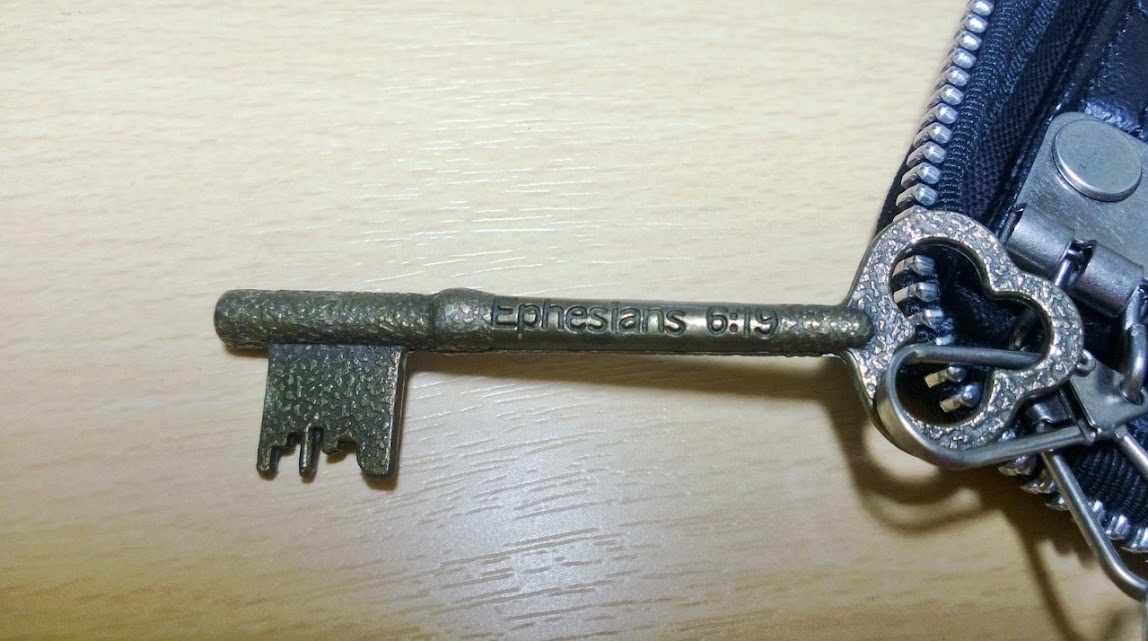
I keep it with all my other keys, so that every time I need to lock the door or use the bike, I am reminded of Ephesians 6:19 and that I have the support of everyone's prayers back home, and certainly yours :)
Related Posts Plugin for WordPress, Blogger...