Sunday, 5 May 2013

Sapporo Trip

A friend from Australia graduated from UNSW last year, just like me. Unlike me, Nina studied commerce, and will be commencing her job at a firm in Sydney around June. Until then, she is in Sapporo, Hokkaido, on short term mission with OMF. I thought I'd make the most of this golden week break and drop in for a visit before she left. Selina also came to visit in the same period. This is the document of our Golden Week adventures.

(Note, I don't show pictures of others on this public blog without express permission. I've included links to these pictures which have other people in them on Facebook (kudos to Selina for taking and uploading them all!), so if you have permission to view them, you can.)


Departure and Arrival


Strange weather
Sapporo wasn't as cold as I expected. Everyone kept saying that the weather there is not receptive to visitors outside summer, but I walked around with a shirt and a jacket (two layers) and it was quite comfortable. Upon initial observation, it appeared all the snow had melted from the roads, but I saw quite a few piles of snow around the place which suggested they cleared the snow manually.
  
Something very strange was that the cherry blossom trees in Sapporo had not yet started to bloom by the end of Golden week this year (which was when I was there). Japan has a unique obsession with cherry blossom trees, which they commemorate with an annual celebration called Hanami. I'll get around to writing more about Hanami at a later time, but the main feature that makes the cherry blossoms beautiful to the Japanese is its brevity. These trees flower once a year, and the flowers drop off in four or five days. Flowering season in Tokyo is supposed to be early April, so I should have arrived in Japan on time (April 1) for the peak flowering period. But due to strange weather patterns, the cherry blossoms well before their usual time, so it means I didn't make it. This time in Sapporo, the cherry blossoms didn't bloom till after their expected season. Very strange weather patterns - I'm disappointed I didn't make in time for hanami this year :( There's always next year I guess.

Sapporo beer museum


The first stop on tour guide Nina's itinerary was the Sapporo beer museum. We had the visit placed on the afternoon I arrived, but due to the arrival time of my flight, by the time we got there, the museum had closed :(

We still got something out of it though. Sapporo is famous for Genghis Khan. Not the war general; he's Mongolian. In Japan, ジンギスカン (jingisukan) is lamb BBQ on a hot plate.


There were a number of specialty Genghis Khan restaurants at the Sapporo beer museum, so we went there for dinner. The service there was really good - they gave us plastic bags to cover our coats and bags. Why, you might ask? Let's just say I didn't want my bag to take BBQ lamb back home as a souvenir. I enjoyed our Genghis as thoroughly as our clothes smelled of lamb at the end of the night. And no better compliment to the succulent lamb than a hearty pint of Sapporo beer. And Nina, thanks for your generosity in shouting us - you really didn't have to, and we are deeply indebted to your hospitality.


Visiting Hokudai
The next morning, Nina showed us around Hokkaido University (北大 hokudai), where she had spent most of her time in Sapporo. I didn't know Hokudai had such an interesting history. It's best known as one of Japan's national universities, but I don't think it's widely purported that its founder is a Christian. According to Nina, the Christian staff workers at Hokudai told her that apparently one of William Clark's demands was that he be permitted to teach Christian theology on campus. His article on Wikipedia certainly suggests he fought very hard to have the study of thelogy approved in what would have been a country largely unacquainted with Christianity, and the current motto of the university, "Boys be ambitious", was quite possibly originally "Boys be ambitious for Christ". I'm certainly impressed by the missionary efforts of Clark, and what he achieved inspires me to be ambitious for Christ also :)


Taboo numbers?
I noticed something very strange about the room numbering on my floor. What I discovered takes superstition to a whole new level. Level 6 to be exact. (because that's the level I was on when I recorded this video).


Sapporo International Church
On Sunday, we all attended Nina's regular church together, SIC. It was a service conducted in Japanese, with real-time English translation provided via an earpiece for those who wanted it. The pastor was actually a Korean OMF missionary, and not a Japanese native, which is really surprising, since Japanese churches usually preference Japanese pastors. I suppose it shouldn't be too surprising, since this church is more internationally orientated. Aside from a very slight accent, his Japanese was native anyway, so that wasn't an issue.


The sermon style was also quite different to the customary three-point sermon from a reformed evangelical church. It was difficult finding one major theme that ran through the sermon, though. I guess I'm not used to that sort of preaching style yet. It would also have helped in retaining the anecdotes if I had understood more Japanese.

Mount Moiwa
We took a ropeway up Mount Moiwa, a 531m high mountain with an excellent view of Sapporo city.


Sapporo Ramen

We tried the ramen at the most renowned ramen shop in Hokkaido. How do I know that it was the most renowned? Well firstly, this shop has been running now for three generations. Secondly, both the owners and their huge flashing sign outside say that it is. But most interesting of all, was what was on the wall inside the shop:

(click to enlarge)

These are signatures from renowned people who have come to eat here. They are almost all Japanese though, so you might not be familiar with many, but I reckon most people know AKB48 (rightmost framed canvas, middle row). I also recognised Aqua Timez. You might be able to find another artist you recognise. The restaurant owners told me that they have more signatures from visiting celebrities than they have room in the shop to display. I believe them.

Between the three of us, we tried their salt butter ramen, soy sauce butter ramen, and miso butter ramen. Personally, I liked the soy sauce butter ramen best. But I just simply love ramen full stop ^^


Marimo
Some friends here in the dormitory asked me to bring back Marimo as a souvenir. At that time, my response "was what on earth is a marimo…?" It turns out that they are apparently quite well known. Have you seen or heard of these before?


According to Wikipedia, aside from Hokkaido colonies are only found in Iceland, Scotland and Estonia. Also according to Wikipedia, they are considered a type of plant. So apparently they will grow bigger, but only apparently about a millimetre per year. I guess we will see, assuming my one doesn't die before that.


Trick(ed) art museum
We heard that there was a trick art museum exhibit being hosted in Sapporo, specially for the Golden Week break, and I was interested. Selina had to catch her flight, so we said goodbye to her first before Nina kindly acted as guide one more time. What we didn't consider, was the waiting time to enter the exhibit. I thought the exhibit might be popular, but to be honest, I didn't expect the wait to be 90 minutes long. It seems I wasn't the only one who was shocked by the wait time. Since there was about 3 hours before my flight back to Tokyo, in order to allow for the train back to the airport and check in time, we thought better than to risk missing the plane. Slightly unfortunate, but on the flip side, we got to have Okonomiyaki instead :D


This was my first time eating Okonomiyaki, and it also happens to be my first time making it too. Nina learned how to during her time in Hokkaido, so she taught me how. The flipping part was the hardest, but more or less it remained intact. It wasn't too shabby, if I say so myself! By not going to the trick art exhibit (which is available in many places anyway), we got to eat a hearty lunch, and have fun doing it :) An exchange worth making.


Interesting street architecture
Despite less than two hours remaining of my time in Sapporo, the eventfulness doesn't end here. We happened to walk in the opposite direction to the train station on our way back, and did so for 10 whole minutes. Why did it take so long for us to realise? Well here's a screenshot of the street layout of the centre of Sapporo. What do you notice?


The streets are virtually all at right angles to each other. The grid-like street architecture is further accentuated by the street name designations - "kita" means north, "nishi" means west, "minami" means south, and "higashi" means east. It was pointed out to me by a friend back in Tokyo that it quite resembles New York street architecture (and naming).


Anyway, we were supposed to go to Sapporo station, so making our way to the equivalent grid co-ordinates of 7 North, 1 West, but instead we went in the opposite direction (i.e. VERY north). The street names don't change very much, so it didn't dawn on us till we got to somewhere around 20 North. A note of caution for anyone going travelling in either Sapporo or New York.
Needless to say, it took us quite a bit longer to make it back. I ended up taking the last train I could without being late, and checked in at the airport 1 minute before the check-in counter closed. Human failures let us down again, but God was good to us as He has been always.

----------------

Big thanks to Nina who organised the whole weekend, despite her busyness both before and after our visit. Prioritising being a good host over (a long overdue) sleeping in, you showed great hospitality :) Praise God also for your willingness to serve Him in a foreign country, sharing the good news of Christ with those who don't yet know Him. God bless in your future ministry, wherever God takes you :)

Visiting Musashi Sakai Red Cross Hospital

First of all, a big public thanks to everyone who has been praying for me. I can attest that your prayers have made a difference, and been a huge encouragement to me. I know that God has been good in answering prayers I've requested, but also prayers I've prayed for others. I was informed by +Michael Tong in our google hangout last night that a non-Christian who visited our church back in Australia whilst I was still there, has attended on numerous occasions, as I prayed that he might. But again to exceed my expectations (and everyone at church, it seems), he has been reading the Bible at home of his own initiative! Praise God. Aren't I concerned he might see this post? I think it would be a good thing for him to know people have been praying for him!
And I don't know if it was because you prayed that I'd get better, +George Mason, but your prayer has been answered, haha. As I promised in an earlier post, I'm documenting the outcome of the specialist visit last week Friday. Apologies for the time delay; it's been a full on week. Also, happy golden week everyone!


I didn't understand everything that was going on, because my Japanese is still limited, but as far as I could ascertain, there were no GPs in this hospital. Since every person who goes to the hospital has at least some idea of what abnormal condition they have, from the beginning you ask for a doctor specialising in the field you want further examination in. For example, I was referred to the respiratory specialists ward. I also saw a neurological ward and a pathological ward. I suppose if you somehow caught three different types of illnesses simultaneously, it's up to you to go to each respective ward for the check-up.

The next thing I was surprised about was how young the doctor who I consulted was. He was a respiratory specialist no doubt, but he looked younger than 30 - although I have noticed that Asians generally look younger than their actual age. So anyway, his diagnosis was the same as the doctor at the university, 咳喘息. No photo of the doctor either. Asking the doctor for a photo would be quite strange.

What was also strange was the design of the medicine, although "different" might be a better description than "strange". Can you guess what the purple thing is used for?


On right left are tablets, but they are seriously tiny. Each tablet was the size of a pimple (ok maybe a fairly big pimple). They are certainly easy to take. I don't know what the proper English name would be for the contraption on the left (in fact don't know what it's called in any language) but it's like an inhalant. You can slide the tab on the spine of the container to expose a mouth that dispenses medicine in powdered form, which you inhale.

What also surprised me, for the worse, was the medical bill. Just a note that the exchange rate is approximately 1AUD = 100JPY.


It might be normal to expect $300 for a specialist consultation, but due to both my limited experience with medical bills and my stingy student perspective on money, it sounds like a lot to me. Even with the health insurance card that all students in Japan are offered, after a 70% discount I still had to fork out $90 for one appointment. The most annoying part is that the receipt doesn't tell me where the majority of my fees came from, since the consultation itself apparently cost $3. Additionally, the medicine set me back $30, also after applying the 70% health insurance discount. The moral of the story is don't get sick in Japan. Especially if you don't have health insurance.

On a different note, praise God that I managed to send out this month's prayer letter on schedule! Thanks for +Lauren Tsang's farewell present, which motivates me to continue sending out my letters on time.


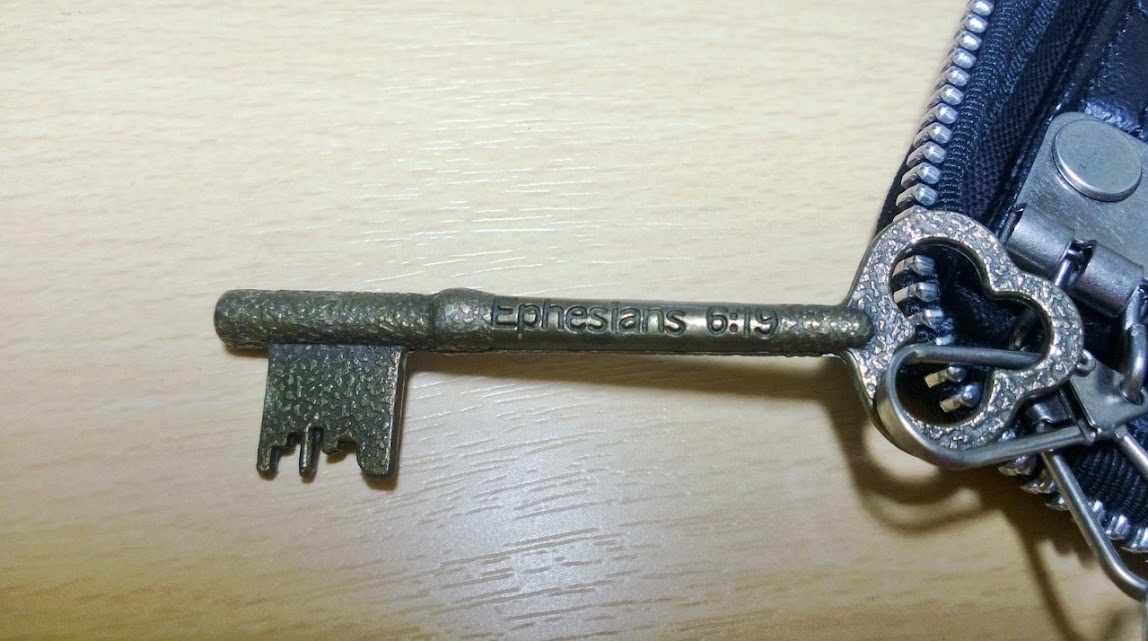
I keep it with all my other keys, so that every time I need to lock the door or use the bike, I am reminded of Ephesians 6:19 and that I have the support of everyone's prayers back home, and certainly yours :)

Tuesday, 23 April 2013

Byouki ni narimashita =.="

Two months before coming to Japan, I developed a phlegmy cough. It was of light to moderate intensity, and remained much the same throughout the whole time. Prior to coming to Japan, it appeared to go away, so I didn't think much of it. However, it's getting close to one month in Japan now, and as of last Friday, my cough got significantly worse. In other words, byouki ni narimashita.

I visited the hospital on campus yesterday afternoon to get a checkup, but the results were enigmatic. My temperature was normal at 36.5oC, the doctor didn't hear anything abnormal using the stethoscope, and the chest x-ray showed no abnormalities either. My three-month-long persistent symptoms, however, definitely say that something is wrong. The doctor could conclude that it isn't a typical cold, flu, or hayfever, but beyond that he could merely speculate. He told me that at my age, the most likely possibilities are either Tb (tuberculosis - I actually studied that for a whole semester in Australia), or sports-induced asthma (He called it 咳喘息). Why the second diagnosis? Well upon arriving here, in my best efforts to remain fit and active, three weeks ago I began jogging every morning. Unfortunately two weeks later, my symptoms aggravated. Of course, there are also other possible explanations to my worsening condition, such as change of diet (or merely not eating enough fruit & veg) or sleeping too late, but again, as of now they are merely possibilities. Truly enigmatic, though.

I've been given a reference to see a cardiologist in a neighbouring city, and I've received permission from my class teacher to be excused from class this Friday to visit. I'll give an update on my cough thing when I learn more. Until then, please don't concern too much for me, as might happen when one mentions they've had the same sickness for three months. That was merely background story to the main reason I published this post, which was to document my first visit to the hospital in Japan, on this scholarship.

These masks are very fashionable during the colder months of Japan.
That's what a foreigner might think, looking at how many people wear them on the streets. Well I get to be fashionable as well for a period of time.

I've already had Christian friends here offering to pray that I'd get better, and I appreciate their concern. Some who read this may also share similar desires, but if you are to pray for me (please do!), you don't need to pray that I might get better. In a nutshell, there are much greater things worth praying for. When we pray for things to be a certain way, we're saying that that other situation is better. We pray for love and patience, because it's better to be so, we pray for peace (both individually and globally) because it's the better way, we pray for Jesus' return because we want to be with Him in heaven, and we pray that everyone might come to know Christ and see His great love for us because that's what we were made for. Praying for better health is certainly wishing that a person's quality of life will improve, but I can't agree that being in a poor state of health is necessarily a bad thing. For one, being sick reminds us that we are physically vulnerable and fragile creatures, limited by time and space. Sickness also serves to make us grateful for good health. And even whilst sick people are commonly disadvantaged in some way against healthy people, it teaches us patience, perseverance, and empathy. For me, my persistent cough has also stood to bring me closer to God over time, in firstly being reminded that He is able to make me well whenever He would like, and that He knows better what is best for me at this given time. Not only that, it also makes me thankful toward God for meeting my greatest need for healing through Christ, for my sin to be forgiven and my relationship with Him restored, as Christ came to Earth to accomplish (Lk 5:31-32). In my sickness, pray not merely that I might get better, but that in my time of weakness, that Christ's strength would be seen and Jesus' name be glorified (2Co 12:9).


On the topic of making God a priority in my life, I have set aside half an hour to one hour each morning for quiet time with God. Each day of the week I base my prayers off a certain theme, from personal to mission to my church, etc., and learn to read the Bible in Japanese a bit at a time. I'm only four chapters into Matthew, and I've already accumulated 108 words (most of them in new kanji) in my list of new Bible vocabulary. I have motivation to keep going, though, because even just comparing my experience of church here on the first Sunday and the second Sunday, through my personal Bible reading the number of words I could understand in the worship songs and the sermon was markedly different. Pray that I'd persevere in the difficulty of learning to read the Bible in a new language, reminded of the reward that I will reap in being able to understand and articulate the gospel in Japanese. I've had many opportunities to have gospel conversations in Japanese over the past three weeks already (praise God!), both with local Japanese people as well as fellow scholarship recipients whose Japanese language ability surpasses mine, but undoubtedly it's still a huge struggle to communicate ideas, when my fellow conversants don't speak English well, so pray that as I gain better Japanese ability, that I'd be able to utilise it in conversation well. じゃ、またね!

Friday, 19 April 2013

Christians at TUFS

Sorry for the delay between my previous post and this one; it's surprising how busy my week has been. To continue where I left off in my last post, we gave (quite numerous) self-introductions (自己紹介) last week in class. Firstly, the basic name-country-areaofstudy. On another occasion, a written version of around 800 characters long in the form of our first writing task. Yet another time, we gave introductions - this time of someone else in the class - and we took turns presenting what we learned about the other person in front of the class as a listening comprehension exercise. We did so many types of self- and others-introductions, that our final teacher last week (five of them take turns teaching us each week) ran out of different methods to introduce ourselves.

If this post was merely me venting about how many times I had to mention I was from Australia last week, it would be about as interesting as sitting through all our class self-introductions (that is, somewhat interesting). However, what makes this post worth writing, is one particular introduction given by another Christian in my class.

I was asked quite early on to introduce myself, and I gave the usual country-subject-family-hobby-etc.; stuff which you'd usually expect first time round. After all, everyone else in the class followed the same pattern - everyone else, except one Ukranian girl. Before she gave her self-introduction, I had no idea she was a Christian (whilst she had no idea that I was also, even after I introduced myself). Her level of Japanese at the time was a long way off from proficient, but even as she struggled to express herself in a language yet foreign to her, she was determined to let the class know that Jesus was the most important person in her life. Not surprisingly, the teacher evaded the topic altogether, choosing not to inquire further about her belief despite asking further questions on everything else she mentioned in her self-introduction. But I was certainly humbled and encouraged at the same time, from realising that it didn't even occur to me to mention my faith when introducing myself for the first time, whilst for her it was such a natural thing to openly voice the value of her faith.

Even though I've been studying Japanese for six years and been a Christian for many more, only last week did I realise that it has not occurred to me even once in that time to mention I was a Christian in a self-introduction. All I've been absorbed in was how to make my speech funny, how to make it unique, what would help people remember me, when all along I neglected to mention what was most important to me! Yes, it's true that it probably never naturally occurred to any (or at least most) of my fellow foreign language learning friends back in Australia to mention their faith either, but I wonder if we should consider that acceptable. Does it reflect our new identity in Christ (2Co 5:17)? Does it reflect the value of our faith (1Pe 1:7)? Do others see a person changed by the knowledge of Jesus Christ (2Pe 1:3)? I was so absorbed in figuring out what made me stand out that I overlooked my most basic characteristic - my identity in Christ. Thanks be to God for first answering my prayers made in Australia to bring Christians into my life. When I prayed that, I did not expect to meet another Christian in a class of 8 people, but it goes to show that God indeed looks after His people (Rom 8:28).

The answer to my prayers doesn't end there! Speaking of God exceeding our expectations, the Ukranian girl I met in my class was one out of many Christians I subsequently met. In our Monbukagakusho scholarship cohort of less than 60 people, so far I've met (aside from the Ukranian girl) two Christians from Bulgaria, two from Thailand, two from Singapore, and one (so far) from Korea. That's over 10%, in comparison to Japan's national Christian population of less than 1%! Praise God!

With the number of Christians on the campus I'll be studying at this year, we could plant our own local church. But praise again goes to God, because we don't need to - there are already two churches in our locale - Tama Church, in the photo below, named after our suburb, and Fuchu Calvary Gospel church. I've attended the former for the past two Sundays, and in that time I've learned that they teach reformed Protestant theology; in other words, the church service style and preaching are just like ALLC - only that it's conducted in Japanese. The latter, however, is an English-speaking church, which I found out about from the two Singaporean Christians who attended it on the first Sunday. I've been told by those who have attended their service that their style of service is more "contemporary", though I can't comment beyond that since I haven't been there (which is also why I haven't taken a photo). I'm more than content with regularly attending Tama Church so far though. God is good.


Having said that I've met so many Christians, the only thing I'm certain of is that they have been Christian up until this point. Upon first impression they are all amazingly eager to continue growing in their faith and staying in touch with the Christian community in Japan, for which praise goes to God, but time will tell how this culture shift will affect our Christian faith. Speaking for myself, I've been faced with many temptations already during my time here of a different nature to that which I had to deal with back in Australia which have tested my faith and love for Christ, and I can't say it's been easy. One thing I haven't been mistaken about prior to coming to Japan was that I can't take my faith in Christ for granted here. If it weren't for the prayers of all those back in Australia, and God's grace made effective in my life through all your prayers, I wouldn't last long at all. So thank you to those who have been praying for me, and special thanks to +Jas Lau for this elephant candle, to remind me to never forget, as an elephant never forgets, that there are people praying for me back home, and also to remind me that God has made me a light to shine in the darkness (Php 2:13-16). Thanks also to others who have given me small gifts of memorabilia to remember both my family of God back in Australia, as well as the God who unites and sustain us; I will showcase them over the weeks to come.


Sunday, 14 April 2013

Two down, 258 to go…

The end of another week. To be honest I'm not sure I'll be in Japan for a whole 260 weeks, but the length of time remaining in Japan versus time already spent is conveyed nevertheless.

I'm not going to do the day-by-day breakdown that I did in my first week recount, firstly because it would look like mondayclasstuesdayclasswednesdayclassthursdayclassfridayclass, and secondly because it doesn't do justice to the notable events worth mentioning. Boy were there many events this week. I think I'll release them slowly, in more specific, bite-sized chunks over the next few days and weeks.

The first event is the announcement of classes. First thing Monday morning, the results of our assessment test were released in the form of class allocations. The 60 or so people who are studying under the same undergraduate scholarship as I am have been placed into a class somewhere between "A" and "G". Class A is the most advanced, and houses those who are already proficient in Japanese, which happens to include the majority of Korean scholarship recipients. Linguistically, Korean is the closest language to Japanese so they lean to speak it fluently very quickly. Class B to about D consists of people who have some form of Japanese proficiency, to various extents. Class E and below are effectively exposed to usable Japanese for the first time. Each class has around 8 people, which is a good size for personalised learning.

Based on my performance in the assessment test on Friday, the teachers at JLC have allocated me to class C. More or less, everyone in my class has moderate to confident ability in Japanese speaking, reading, writing and listening. Of course, the Japanese background of everyone in the class is different, so I can't make any generalisation. Some people in the class have learned Japanese academically for many years like I have, whilst others in the class have (amazingly) self-taught themselves Japanese over many years through a variety of means, from studying for the JLPT in their own time, to speaking to Japanese people in Final Fantasy MMOs. Everyone in the class ranges from trilingual to tetralingual (notsureifthiswordexists) to varying degrees of fluency, and I feel right at home amongst them. For once in my life, I can speak my English, Japanese and Mandarin Chinese interchangeably in conversation and be considered normal by the group. This isn't limited to just in our class! Virtually everyone under this undergraduate scholarship is trilingual, so it's effectively Big Bang Theory in our residential hall, except in our case it's geekiness of a linguistic kind that we share in common.

Anyway, back to class C, it's been a pretty enjoyable first weeks on the whole. I do admit that I have found the learning content this week to be ridiculously easy, since it's been revision of content equivalent to year 10 Australian high school Japanese, but I acknowledge that the teachers have good reasoning in choosing to begin here, and I'm also aware that I'm not the only one in our class who would like to go a little bit faster (actually, skip a few years ahead). The difference in perspective on education between the (native) Japanese teachers and us "gaijin" (Japanese cultural mini-lesson: gaijin is a term used to refer to non-Japanese people in Japan, connotating ignorance of Japanese customs - which are many, for the record) is that we are happy with an 80% mastery of the basics, whilst they expect 100%. No doubt I was surprised that I got one mark taken off for barely a pencil twitch in an otherwise perfect effort.


To be fair on the others from my class who may be reading this blog post, I empathise with you over the marks you don't reckon you deserve to have lost. I feel the same way. But since the teacher decides what marks we get, our duty is to acknowledge the mistakes she points out and to fix it for next time. To verbalise the diagrammatic metaphor, we are performing maintenance on the foundation upon which the rest of our Japanese language will be built upon, therefore nothing short of flawless will suffice in this earthquake prone country, which is why we need to fill in the chips in our initial foundation built back home.

So that's the Japanese learning component of my first week of semester covered. More to come in future posts :)

To do list
An updated version of last week's to do list.


  • Obtain a dorm room (done!)
  • Register my existence at the City Municipal Office (done!)
  • Open a Japanese bank account (done!)
  • Get health insurance (done!)
  • Fill out contract for utility bills for my dorm room (done!)
  • Get a Japanese SIM card (done!)
  • Send out first prayer letter (done!)
  • Pay my dormitory rent and security bond (no security bond, monthly automatic payment set up)
  • Pay tuition fees (monthly)
  • Have my arrival interview with the Associate Professor (hopefully next week)

Saturday, 6 April 2013

One down, 259 to go…

If you were wondering what the numbers in the title are referring to, here's a hint: there are 52 weeks in a year :)

So after a chaotic, confusing arrival, I think I've finally gotten into the groove of things, and made a few new friends in the process. Classes begin 8.30am from Monday next week, so this week was to help us get orientated. And boy were there many orientations! Here's what happened this week in retrospect:

Monday.
Left Sydney at 9.15 and arrived in Tokyo at 5pm. Got stuck in the customs line for one hour, and then wandered around for an additional hour waiting to hear from TUFS that never came, and took an hour to reach my dad's place. Will attempt to travel to TUFS tomorrow. Recorded vlog of my dad's place.

Tuesday.
Went to take photos of Sakura blossoms with dad (Just missed peak Hanami season in Japan, but there were still plenty of trees in blossom!)


Successfully reached the TUFS campus with two massive luggage cases in the pouring rain by evening, with assistance from my dad. Recorded vlog of my dorm.

Wednesday.
Orientation session #1: Orientation to everyday life in Japan. This involved learning that over 10,000 earthquakes occur in Japan every year, if you count ones you can't feel. Though I doubt we need to know about ones we would never have felt in the first place, but they certainly succeeded in scaring us over earthquakes. I wonder how many earthquakes we couldn’t feel happened in the time it took to show us the video.

Had my first meal at the university cafeteria over lunch. Forgot to take a photo of my upsize ton-kara ramen >.<! (大盛トン辛ラーメン)

Took an excursion by bus to the Fuchu City Municipal Office to have our existence recorded. Also set up Japanese bank accounts at Japan Post Bank. Now I have an official permanent address in Japan! If you have permission to view my Facebook profile, my mailing address can be found here.

Orientation session #2: Gaining authorisation to use TUFS wifi and computers on campus.

Ate out for dinner at a "Izakaya" to relish our legal age to drink. Also to experiment. It was more valuable as an experience than as a meal. Ordered some dishes we didn't know the name of that didn't meld with our palate. Special mention goes to this frozen squid stuffed with a soy sauce and fish base; the first mouthful caused me to gag. I wasn't the only one.


Thursday.
Orientation session #3: Formal university entrance ceremony. Heard speeches from five important looking Japanese people who could speak English pretty well. That's pretty unusual! One particular message stuck with me - "think global, act local". Very remarkable to hear such a motto in a nation as homologous as Japan! This campus specialising in foreign languages is leading the nation in embracing what I call "global shrinking". TUFS not only acknowledges the increasing adeptness of other countries at harnessing the power of the internet in bringing people around the globe closer, but has turned it into an asset and an advantage in their constant pursuit of remaining global leaders in foreign language education. Respect.

Visited Kichioji (吉祥寺) to buy technological paraphernalia at Yodobashi camera. They were holding some promotion on level 8, which made me feel special. Global shrinkage, local magnification.


Stayed up revising for the placement test tomorrow. Minimal facebooking tonight.

Friday.
Orientation session #4: Orientation to life over the next year at JLC. Got a better idea of how intense the coming year will be. Full time study 8.30am to 5pm, Monday to Friday, with expectations to revise a minimum one hour every night if we don't want to fall behind. It won't be purely Japanese language study though; we will be doing a variety of other subjects from amongst Japanese history, mathematics, science and PE, depending on our field of major.

Assessment test for most of the day. First stage, 80-question multiple choice and short answer test. Next stage, 5-7 minutes interview. From these results, we will be divided into respective classes, in which we will remain for the rest of our time at JLC. All classes will reach a level of Japanese proficiency sufficient for tertiary education (assuming you keep up); the difference between class A and class E will be how polished they are.

Went to eat at a sushi train (回転鮨). Couldn't all fit at one table, so we sat at two. I ate about eight plates; each plate had two pieces of sushi and cost 105 yen (soooooo cheap!!!!).

Went shopping around Fuchu city. Didn't buy much, but it was good hanging out with a bunch of fellow Monbukagakusho scholarship students studying at JLC this year. Learned a new term from a Norwegian friend: "Gaijin bashing". It's where you go around ordered, courteous Tokyo as an ignorant foreigner, walking into deceptively welcoming train ticket barriers, unwittingly cutting the line, and such. We even had a first hand experience walking along the footpath as a massive mob, blocking all bicycles, which was a problem because a good 50 or so bikes passed us. You should have heard us - every time, like seagulls

First prayer letter overdue.

To do list
Looks like I've got a fair few settling in tasks to complete.

Checklist of things to be done
  • Obtain a dorm room (done!)
  • Register my existence at the City Municipal Office (done!)
  • Open a Japanese bank account (done!)
  • Get health insurance
  • Fill out contract for utility bills for my dorm room
  • Get a Japanese SIM card
  • Pay my dormitory rent and security bond
  • Pay tuition fees
  • Have my arrival interview with the Associate Professor
  • Send out first prayer letter
Acquire work permit (apparently this will put my scholarship status under jeopardy)


    Wednesday, 3 April 2013

    Final destination [vlog #3]


    NOW I've reached where I'm supposed to. In the brief few hours I had yesterday between the recording of my vlog and when I slept (at around midnight), I made a few friends, both first years (like me) and upper years, just taking a walk around the place. One particular guy I met had just finished at the language school where I'll be studying at this year, and he was figuring out how to fit a Mac desktop that he found into his luggage case, and carry it to his new campus Saitama University. He gave a few insider's tips as he attempted to shove an oversize desktop computer into his bag.
    One such tip, interestingly, was study hard. Apparently he was only granted his second preference of place of study - first being Tokyo University of course. I myself hope I'll be able to give my Japanese studies decent attention, because that was one of my main aims coming here to begin with as I mentioned in my first vlog. Another tip was to make friends with as many people here as early as possible. That's something I've been telling all the first years at UNSW over the past three years to do, and I'm glad he reminded me of the same thing in my time of disorientation. Something tells me we're going to get along well. The people living in my residential building aren't just first years on a scholarship like me - there's also full fee paying international students, and upper years specialising in language and arts subjects, and I won't know who's who till I ask them! His third tip was interesting - it involved finding your way back inside the building without the key card we were issued. Very handy! - who knows, it might save me freezing to death if I ever get back late one night and I happen to forget my key card.
    Eventually he (amazingly) fit the baggage he needed to carry all around the seriously huge and heavy mac, and was on his way. Hope he gets there safely. He said he'll be back yet, so it won't be the last time I'll see him; as long as there's free food and parties here, he has a reason to return.

    So in light of that, please pray I'll take my studies seriously while I'm here, as an investment into building relationships in Japanese. At the same time, pray I wouldn't let my current limited language ability get in the way of getting to know people and building relationships. In all that, pray that my identity in Christ would shape the way I interact with them, and that Christ would be known among them too.
    Related Posts Plugin for WordPress, Blogger...