Sunday, 20 October 2013

Holiday in Okinawa

In publishing this post, my account of the summer holidays officially comes to an end. Most of why this post took so long, was because of the amount of photos I had to sort through to find the good ones to post here. For anyone who is interested in all 600 or so photos, you'll find them in my Flickr album.


My dad and I went holidaying on the main Island of Okinawa over a period of four days, August 12-15. The main island of Okinawa is fairly stretched out from north to south, kind of like this:


So in order to best explore the whole area, we rented three different hotels over three nights. We also rented three different cars. In hindsight, exploring Okinawa by car gives you immensely more freedom than relying on the public transport system. The airport on the main island is in the southwest corner, if you look carefully. The public transport system (consisting of a light rail system pictured below) only covers the bottom third of the island, so that makes it quite difficult to, for example, get to the aquarium about two-thirds of the way up the island.


Day 1: World heritage sites


The US army base is surprisingly close to the airport. Obviously we weren't allowed in, but it was cool to take photos around its vicinity. Hang around long enough, and you'll eventually be rewarded with a sight like this:


A massive downpour started as soon after we picked up our rental car. We were so glad it was right after we got the car.


We spent a good part of the first day visiting all the different world heritage sites in the bottom third of the island. The first thing that surprised me was how many world heritage sites there were. A lot of primitive castle structures characteristic of Okinawa had been well preserved, and been labelled cultural heritage. Taking a look around these castles, you quickly realise why they are so worth preserving.


This is a 360 degree panorama shot taken from one of the vantage points of one of the castles (I forget which)


The views from the vantage points are excellent, and they are valuable as both watchtowers to the inhabitants of these castles long ago, as well as to tourists today.

In between visiting world heritage sites, we made the most of having a car by driving on the many amazing bridges that connected some of the more significant smaller islands to the main one. Bridges like this:


On the other side of the bridge, some pretty nice beaches greeted us. Check out the water:


Surfer dad

You couldn't really surf here, but it's perfect for swimming. There were many beaches like this one, great for not only swimming but also jet boating, and something I found quite interesting, banana boating.

However, something I found quite peculiar was the existence of paid beaches:


As an adult, you had to pay 1500 yen (about $15) to enter this beach. It looked like an ordinary beach to me:

You can see a real life banana boat in the distance.

We ended up hopping back in the car and moving on fairly soon after finding that one.

Rental car on the first day

Day 2: Snorkelling + scuba diving

On our way to the key event of the day, we passed by the traditional Ryukyu village. "Ryukyu" is the former name of Okinawa, and inside we got to see some characteristic Okinawan things.


Photo of two dragons and one wannabe dragon. Oh, and in the background is the word's longest dragon made of rope.

Shamisen, a three-stringed predecessor of the guitar and a traditional Okinawan instrument.

A god of the Okinawans, believed to bring good luck or something

Iconic Okinawan dance

Something I found quite intriguing was this pit viper museum (pit viper is called "habu" in Japanese).


Inside, there were both live vipers and model vipers on display. There was also a live mongoose in a cage opposite a caged habu. And most fascinating of all, habu wine. 35% alcohol content.


This is one chilled out pig.

Even roadwork in Okinawa is tourist-friendly.

And now for the feature event of the day: snorkelling and scuba diving! It was a first time experience for both dad and I, and I for one was looking forward to trying it out for a really long time.


I was extremely surprised at how fearless the fish were around people! We swam right past them and they just kept on doing their thing. When we gave them bait, I was able to stroke one of the fish's backs. It’s an experience I highly recommend to anyone who is daring enough to give it a try.


Okinawa Drift.

Day 3: Aquarium

Rental car number two.

On our way to the aquarium, we visited the Okinawa Pineapple Park. Initially we thought it was like a kids amusement park, but we were gladly soon proven wrong.


It was actually a park full of everything related to pineapples. We were taken on a tour on a toy car around the pineapple farm, given ripe pineapples to eat, watched people cutting up pineapples in the factory, saw the pineapple wine cellar, and of course bought a few pineapple souvenirs. It was a surprisingly fun experience.

How growing baby pineapples look like.

And now the showcase event of the day… Chura Aquarium! It was unbelievably massive. It wasn't just a big fish tank sort of aquarium, there was also a petting pool, dolphin show, dugong enclosure and the main aquarium feature, whale shark feeding.


This picture demonstrates just how large whale sharks are.


Dad imitating a whale shark

One day wouldn't be enough to explore the whole place. The aquarium is definitely one reason to visit Okinawa again.

Some more military planes flying overhead.

Even Doraemon likes to holiday in Okinawa.

Day 4: Everything else

When we were planning our Okinawa trip, we had some doubts whether this small island had enough to keep us occupied for four days. Even some of dad's work colleagues (who hadn’t been to Okinawa, mind you) were surprised that we were going for so long. By the fourth day, we were convinced that the answer was yes. Actually, the answer should be "not enough"!


While cruising around parts of the island we hadn't explored yet, we came across this ferry bound for some nearby island. We decided why not, so we went and had a look. The island's name was Kudaka Island, and apparently this island is home to a pretty high status god as regarded by all the Okinawan people.


On the map, the red mark somewhere around the middle of the island indicates where the god resides, and is prohibited to the public. I really wanted to go and see what was there, but due to limitations on when the ferry back to the main island would come, I didn't have time. Maybe someday.


We next visited the memorial peace park. This place was erected in memory of the war-scarred history of Okinawa.


All 48 prefectures of Japan contributed financially to the construction of this memorial park, and all 48 prefectures have a small patch of land within the memorial park with sculptures that are characteristic of each prefecture.

There was a fairly extensive war memorial museum, which I quickly perused in our limited timeframe. Though it was rushed, I was still moved by the written, illustrated and video records of the battles and wars that had occurred on Okinawan soil. This small land has certainly had its fair share of strife and conflicts. I read the transcripts of interviews conducted with survivors of the wartime, translated into English. Family members witnessed family members being blown in half by shells and their shockwaves.

We used up our remaining time in Okinawa by driving to the southernmost tip of the island. The views were worth it. There were quite a few people surfing and body boarding in the waves there too. This place is going on the to do list for the next Okinawa trip for sure.


An Okinawan hermit crab.

Final thoughts
Some advice from a tourist who's been to Okinawa. As long as you have a car to get around, you could spend a week in there and still have things to do. We had to cut items out of our itinerary because we ran out of time. I wish we had room to go swimming at those beaches! People also say Okinawa is too hot to come visit during the summer. I don't know if this year was an exception or not in terms of weather, but I didn't find it that different to Tokyo in the same time period, give or take a few degrees Celsius. In which case, I'd much rather spend it in Okinawa instead.

The traffic on the roads was very reasonable. Though all the holiday packages and rental cars were booked out for the period we were in Okinawa, meaning it was a peak period of tourism, the roads were very reasonable. I would even go so far as to recommend not taking the motorway that is theoretically designed to make traversing the island faster, since it often gets congested. Instead, drive along the coastline instead! We didn't have any problems with traffic 95% of the time and even when we did, there was a great view to enjoy while we waited.

Last but not least, I found the people in Okinawa to be surprisingly friendly. With all these great points, it's easy to see why it's such a popular tourist destination. Can't recommend this place highly enough. Defs coming back when I have the chance.

Thursday, 17 October 2013

Nagano trip

In celebration of the end of exams, we went on an overnight bus trip to Nagano Prefecture with our entire cohort. In total there were 54 foreign students in our program, 4 teachers and 11 Japanese students.

Our first stop was the Suwa taisha, a Shinto shrine. What's a trip around Japan without visiting one of these. Some people went to try their luck at the lottery available at Shinto shrines which apparently tells you how lucky you are. We also saw many wooden plaques hung with prayers written on them, most of which were about academics or getting a job. There were some things explained to us about characteristics of this particular shrine, though for me overall it was mostly a time of just admiring the architecture, since I didn't have much to do with its religious aspects.

Wooden prayer plaques

Shingen Mochi, a delicacy in Nagano. It was very yummy :)

Next we visited a wasabi farm. This was a unique experience, since it was apparently the largest producer of wasabi in Japan.

Statue of a wasabi plant.

Wasabi require a lot of fresh water, and apparently several hundred tonnes of water are run through the plantation each day.

We walked around the wasabi plantations, and at the end some people tried some "wasabi ice cream" and "wasabi beer". I personally was disappointed that the beer was normal beer with shaved wasabi added into it, instead of being brewed from the wasabi plant. The ice cream was just vanilla with shaved wasabi added into it. Neither tasted distinctly of wasabi.

We then visited Matsumoto castle.


What was particularly meaningful to us arts students was the fact that we had just learned in history class this half semester about the Shogun who had this castle built. The narrow staircases that connected the five floors of this castle were also interesting. They were apparently specially designed to make it difficult for invaders carrying swords on their backs e.g. ninjas to climb, since their swords would get stuck between the handrail beam. Very strategic.

The fish in the moat were very friendly.

At night we stayed at a traditional Japanese inn, called a ryokan, and had traditional Japanese meals for dinner and breakfast. Aside from the sake wine being withheld from our meals, it was certainly an experience to behold.

Traditional Japanese dinner

Traditional Japanese breakfast

Japanese meals are famous for being not just pleasing to the palate, but also delectable to the eye. One saying we learned in class was Japanese eat with their eyes as well as their mouth. The variety was amazing, and so was the quantity of dishes they would have had to do afterward. Everything came in small quantities, but there was overall so much food that even I struggled to finish it all (but eventually did in the end).

The next morning, we set off again by bus, headed back home, making various stops along the way like the day before. Our first stop was the Zenkoji Buddhist temple. We weren't permitted to take photos inside the temple.


It was really beautifully decorated, which makes sense of why it's such a popular tourist site, but visiting a shrine and a temple in such close proximity of time once again got me pondering upon the syncretic nature of Japanese religion. The way they seek to bring the two into harmony instead of accepting one and rejecting the other reflects upon the Japanese culture.

Our next stop was having a crack at making buckwheat (soba) noodles.


Four were assigned to each table, and we cooperated in first making the dough from the pre-prepared flour, then rolling it flat and cutting it into noodle strands. After we had made the noodles which took about 40 minutes, we divided into four portions and took them home. We were advised to eat them as soon as possible to enjoy the freshness, but I didn't eat mine until lunchtime two days later, by which time a lot of water had evaporated and it started smelling differently to when it was freshly made. It wasn't inedible, but it didn't quite taste like the handmade noodles we had at the ryokan during dinner, haha.


Our last stop, was my personal favourite - apple picking! We were allowed to pick as many apples as we could eat on the spot. What was unfortunate was that we only had about 30 minutes to apple pick before we had to leave so I was only able to eat five apples. There were six varieties planted in that particular apple farm, so that meant I didn't get to try all of them. But the ones I did eat were certainly very tasty.


Overall it was a good break. Unlike my various holidays during the summer break though, this had a heavier emphasis on sightseeing. Though we theoretically visited Nagano, it felt more like just having fun in Nagano than getting to see Nagano itself.

In class today we learned about a certain village in Nagano Prefecture called Shimojo. What's interesting about it is that although Japan as a whole has been experiencing a continuous decline in the birth rate for about 30 years, Shimojo has actually seen an increase. We learned about the cost cuts made by the government to subsidise housing for families, and to build parks where mums with young children could spend time together, amongst other things in order to encourage childbirth. Taking some time out to visit somewhere like this instead could possibly provide a better perspective of what Nagano is really like, not just as a tourist attraction. Still, our trip to Nagano brought us closer together, and we got to know better both foreign students and Japanese students alike.

Autumn mid-semester exam results

Mid-semester exams timetable

So I finally get around to publishing a post on the day that I intended to. Today we finally received all of our results from our mid semester exams that ended last week. Although it is unthinkable to receive our exams back so early in Australia, the reason I say "we finally received" is because last semester, the day after exam period ended, we received all our tests back.

Anyway, here are my results, both to inform those back home as well as for my own future record.

Japanese reading
92
Japanese listening
93
Kanji writing/reading
100
Japanese grammar
98
Politicoeconomics
81 85
Japanese history
100

The tests for Japanese were noticeably more challenging than the last time around, as are reflected in my results. Having said that, I didn't get that many wrong - one question was commonly worth 3 or 5 marks, so one incorrect answer brought you down from 100 to 95.

I'm extremely happy to get 100 in history this time round. Having solely studied science subjects for most of my life, I'm not much of a history person. The thing I hate the most about history is the fact that it's 10% understanding and 90% memorisation - the opposite of chemistry and mathematics, for example. But somehow as long long as something is somewhat related to Japan in some way, I have more motivation to learn it. It was with a personal desire to understand Japan's history better that I studied it this semester. The more I learn, the better picture I get of this country. And admittedly, my prejudice against history is slowly changing as I grasp the value of seeing myself against the backdrop of a bigger slice of the time spectrum.

Another subject I thought I'd point out, is that just like last time, politicoeconomics happens to be the only subject where the marking scheme was altered after the exams were marked. I emphasise that what was modified was the marking scheme itself, which personally is a bit beyond my comprehension. It meant that the one setting the test (same guy as last time, and same guy for at least the past 10 years in this program) didn't really know what he was looking for from us. How are we supposed to know what to offer if the teacher doesn't? I'm beginning to feel sorry for the teacher for my condescending attitude at his teaching style, and do acknowledge that he deserves some credit for what he does. It's only hearsay, but from what I understand, he's past the age where he can legally retire, but the school has retained him because there's no suitable replacement for his position yet. I guess he's thinking he wants a break now as well, though he probably has much on his plate by this stage. People inevitably get busier the older they get. I've been observing that also in my life and that of all my friends over the five years since it first occurred to me.

Friday, 11 October 2013

Textbook Japanese or Everyday Japanese?

I had a great time with all the foreign students in our program (and some Japanese students also) in Nagano over the past two days. Details of the trip itself will be published hopefully over the coming weekend, but for the moment, I had the impulsive desire to share some reflections as a foreign learner of Japanese. I've been more scientific than artsy for most of my life, and I have never blogged let alone have impulsive urges to write a literary piece before coming to Japan, but I guess people change.

The following musings and their applications should have relevance to the learning of other foreign languages too, but they are particularly significant for the Japanese language. This is because Japanese is commonly known as a "high context language" where what you say takes equal precedence - and sometimes is even less important than - what you don't say, and also additional factors such as the age of the other person, how close you are with them, etc. This means that the difference between the language form taught by textbooks and the language seen in everyday situations markedly differs. For example, there is no English language equivalent of honorific language (敬語 keigo) which is characteristic of the Japanese language.

To correct the first common misconception, textbook Japanese does not teach you everyday Japanese. Chances are, you've heard this more than once, just as I have. But I for one didn't grasp to what extent this applied. While eating out with both Japanese and overseas students today, it dawned on my conscious self for the first time how little overlap there was between written and spoken Japanese in terms of both vocabulary as well as grammar (and use of particles, unique to Japan).
For example, when you write an article, you have to use full sentences, but in conversation, finishing mid-sentence is often the accepted norm. The listener infers the rest of what you're trying to say. An example of a natural spoken phrase would be 「お大事に」, which directly translated would mean "preciously". Its meaning is closer to "Hope you get well soon" (when someone is sick). Most of the sentence is left out because both parties understand through context. They also know what the full sentence is supposed to be, so there's no need to say it all. Obviously, this instinctive ability to piece together the pieces of unspoken linguistic information is negligible in the student of Japanese accustomed to forming perfect grammatical sentences. On the contrary, speaking in full sentences all the time would bore your native Japanese listener, who understood what you wanted to say by the second word of the sentence but has to wait for you to finish out of politeness. It wouldn't do favours for the natural flow that conversations are fuelled by.
A second example is the difference in the formality level of the vocabulary and grammatical structures between written and spoken Japanese. From our conversation tonight, is responding to some event or occurrence mentioned by saying it's not uncommon. In written form, saying 「少なくない」 (sukunakunai) is acceptable, but in conversation, using 「マジだよ」 (maji da yo) is more natural. The former is too formal, and vice versa. The same goes for grammatical structures, right down to the order of words in the sentence. This occurrence exists in the English language too, but not to the same extent.
Learning from a textbook teaches you how to communicate a given idea from your native language to a Japanese person in a way they understand. Simply by progressing far enough with a textbook-based approach, you can reach the point where you can articulate the same idea in Japanese as your native language. However, don't think that that means Japanese people would approve of your choice of linguistic expression in a conversational setting, if you use only academic style Japanese. In fact, you can easily offend people by caring only about the accuracy of your vocabulary and grammar structure, while failing to read the context in which a conversation is taking place, such as speaking to your boss or an important country representative in the default I-met-a-new-person level politeness of Japanese that is always taught first for supposed linguistic safety.

To address the opposing common misconception, everyday Japanese does not equip you for academic Japanese. The same problem occurs in the reverse, namely that the unique elements of high-context conversational Japanese are missing in written form.
One example of a crucial missing element is body language and the dynamic nature of conversation that is absent in a written piece of work. Because of that, you need to rely entirely on choice of words to convey your meaning fully to your audience. That means a lot of abbreviations acceptable - sometimes preferred - in conversation need to be written out in full, e.g. (なくちゃ=なくてはいけない), (きれいじゃん=きれいではなかろう), (なきゃ=なければならない). Also, a lot of sentence-opening leading terms in Japanese serve no greater purpose than to add emphasis to the verb that comes at the end of the sentence, like 「なぜなら」 to indicate a reason will follow, 「もし」 to indicate a hypothetical will follow, and 「たぶん」 to express a degree of uncertainty in the remark that follows. Not to mention that different sentence-opening leading terms will be used in written pieces to replace these terms that have a conversational buzz to them, when using these terms in a written piece, the appropriate sentence ending must follow the respective sentence opener, despite the fact that the listener already knows how the sentence is supposed to end from the opener.
Another crucial contextual difference is the level of intelligence conveyed through choice of words. A lot of adverbs that have a small 「っ」 in them sound a bit more childish, and therefore are used conversationally, with a more formal sounding equivalent reserved for written Japanese. Examples include 「やっぱり→やはり」, 「やっと→つねに」, 「いっぱい→多い」 etc. There are also numerous ways to express the English conjunction"therefore", interjection "but" and even the question marker "?" in Japanese, and which one you choose depends upon context and fomality.
One aspect I find particularly interesting is the replacement of Japanese sounding words for Chinese-sounding words in academic texts. What I mean is this. The Japanese "imported" the kanji alphabetic script from China, and with it, the respective characters' readings. In Chinese, any given character has only one reading, but Japan decided to also ascribe to each Chinese character the Japanese pronounications (i.e. the Japanese spoken language which up to that point lacked a written accompaniment), and this resulted in any given kanji character commonly having four or five different readings which all were related but had a slight nuance in some form. For reasons beyond my current ability to explain, Japanese people regard the Chinese readings to be more "intellectual" than the Japanese readings. Which is significant, because when these kanji characters are conjugated in Japanese, the Chinese readings are almost always used to read the resulting word. This word has the compounded and narrowed meaning that results from its constituent individual characters. Even if you know how to speak conversational Japanese, if that is all then you are at a disadvantage when it comes to distinguishing which word is of Japanese origin and which is of Chinese origin, thus affecting the overall academic aura of your written piece.
Never engaging in academic study of Japanese will, in the instance you are required to write a piece in Japanese, result in your work being evaluated less highly than it ought to simply because it either possesses a childish or a conversational style of expression that a supposedly academic piece should not have. According to our Japanese teachers, native Japanese university students today still get penalised for using an inappropriate formality of linguistic expression in their written pieces.

In light of this discussion, I would slightly disagree with the all too cliched conclusion of "both are equally important for different reasons". I don't think it does justice to the glazed over nuanced differences. At the end of the day, humans are systematic learners confined to space and time so everyone will need to choose which to master first, and which to leaver for later. The answer to that dilemma will be found by asking yourself why you are learning Japanese. If it's because you want to work, study or come to Japan under related official pretences, learning Japanese by the book is the way to go. After you've passed the test that gets you to where you want to be at, you can enjoy slowly learning the language of the local people. I would also argue that tourists should learn by the book too, but obviously they only need to learn the basics so that they can be understood when it really matters.
On the other hand, for those who want to truly understand Japan, its culture and its people, there is no substitute for mixing with the locals, making Japanese friends, and learning on the go, on the field. No textbook will do justice to the many and varied nuances that are intertwined within the fabric of the culture that birthed it, and there is no better way to pick up how a Japanese person would express the same thing you want to say.

The application I gained for myself at the end of this reflection piece is that I should seek to spend time with Japanese people more. Over the course of this year, the language center will meet our academic language requirements in abundance. My grades in each assessment will be a good indicator of how well that is going. But what is less clear-cut is true language proficiency, namely the ability to connect with a people not just by words alone, but through your choice of words, to connect with a different culture and ultimately within that culture, another individual.


I exceeded my own expectations by writing something like this off the top of my head. People are constantly changing and adapting, but change needs time so this fresh new artsy thought process of mine is still in development. I still hope that I gave others who may be reading this insight into the art of learning a second language for themselves. Special mention goes to the Japanese and foreign students alike who made me think not only about the contents of our conversation, but also the way I (and others) conversed.

Wednesday, 9 October 2013

Another half semester down!

I am so happy that mid semester exams are over now that I wonder whether my feelings can be communicated through my words. Bit by bit, my quiet time with God has shallowed in time and quality. This semester has become hectic to the point where I don’t even have time to reply to my email messages. In other words, happenings in my local world are such that it leaves no room for the digital world, so apologies for my absence from my blog. Having said all that, I am nevertheless thankful to God for the fulfilling local world experience that have eventuated. And at the least, God has granted us Christians from this program to continue meeting weekly to read His word and to pray together without interruption. We met up again today, in fact, and it was a time of encouragement.

In the big scheme of things, many, if not all the students in my program are struggling with fitting everything into the time frame we are given. It hasn’t all come unexpectedly, as have been warned about this autumn semester. It appears that this semester's results, and only this semester's results, are submitted to our prospective university. That means two main things. One, this semester's results are incomparably more important than both the previous semester and the next one. Two, our cohort has suddenly become competitors, not friends.

Well ok, on the last comment, to be accurate it's not exactly everyone competing against everyone. If two people want to study the same major at the same university, there's competition, but if not, then it's ok, they can remain your friend. Having said that, there are about 15 people in economics and most of them want the best university possible. I'm glad there isn't that sort of competition for education. As of the moment I know of one other person, and our preferential universities are from different regions.

Anyway, to pick it up where I left off, we just completed our mid semesters:


Friday 10/4 Politicoeconomics (why is it always first??)

Monday 10/7 Kanji reading/writing
                          Japanese history
Tuesday  10/8 Japanese grammar
                          Japanese listening
Wednesday 10/9 (Today) Japanese reading and comprehension

And best part of all, Thursday and Friday (10/9-10): Excursion! :D We are going to Nagano city and Matsumoto city in Nagano Prefecture by bus with our entire cohort, four teachers and 11 Japanese students. We'll be leaving early tomorrow so gotta sleep early :P

But for the moment, a few comments on why the semester has been so busy. First is politicoeconomics. I have vented enough already so I will refrain from repeating myself, but I will say that I spent at least 5 times more in both time and effort for this one subject than any other over the final week leading up to exams. And I wasn't the only one who lost sleep over this subject. It wasn't because it was particularly difficult, since Japanese history (and getting high marks in Japanese) was about as difficult, but the completely disorganised structure of the subject combined with the increased expectation that comes with having progressed half a semester further meant that we didn't quite know what, or how, we were supposed to revise. As a result, our study efficiency was reduced, and thus the increased labour. I am pretty sure it is still going to be my lowest scoring subject nevertheless.

History, as well as the other Japanese tests, were structured quite similarly (which meant structured predictably) to the previous semester, so it was overall fine. Just put in the hours, and the marks will come. It was indeed straightforward, but some may view it as too artificially academic. Majority information recall questions and negligible idea synthesis questions means we aren't examined on whether we truly understand the information. But considering where we are at with our studies here, I think it's an appropriate means of solidifying our foundations at the very least, for tertiary level thinking when we enter university. Not to mention it standardises the grading for university selection next year. The above reasoning applies in the reverse to politicoeconomics, as it should have been made apparent.


Our results will come early next week, when I'll post them up just like my previous ones. Till then, Nagano, here we come :D But first some sleep.

Saturday, 21 September 2013

ESC2013 - Nasu city, Tochigi prefecture


Continuing my summer holiday recount, I was selected along with 249 other foreign students to teach English to Japanese junior high school students at English Summer Camp held at the Shirakabajo campsite in Nasu, Tochigi. There were indeed 250 foreign students helping out altogether, but we didn't all go at the same time. Instead, the leaders were divided into 12 groups (rounds), for the 12 respective schools that participated. All of the students were 2nd year junior high schoolers.

There was one condition for all the leaders: do not speak Japanese with the children! You must speak in English. Before the camp, I was thinking that wasn't too unreasonable. They're here to improve their English after all. Can't be that bad, right?

Pre-camp prep
I was a captain in the 10th round of the camp, which was held 9-11 August. The night before the camp, the captains for my round gathered for a briefing, and to receive our shirts:


In our round, there were 27 captains all from different countries (excluding two Chinese girls). We stayed in a hotel overnight, and made our way to the campsite in the morning.

Day 1
We met all the kids, and found out who was in our group. Six to seven kids were assigned to each captain, and most of the camp's activities were conducted in these groups. I was glad to have three kids out of six in my group able to understand any English at all, because apparently many groups has at most 1. Having said that three kids understood English, in characteristic Japanese style, they tended to pretend their English was worse than it actually was. Initially I actually thought they couldn't speak any English at all, which would be a very troublesome three days since we weren't allowed to speak Japanese to them. Slowly over time, they became more relaxed and were willing to engage in English, and even tried to understand more challenging conversations. It took the most of the three days to happen though!

To facilitate the relationships between the captains and students and encourage them to open up, we began with some ice breaker games. One game we played was a cross between scissors paper rock and gymnastics. This was a snapshot from our game:


In the afternoon, we showcased our country's culture. I showed my kids some of Australia's famous animals, buildings, and landscapes. They also learned correctly that Canberra, not Sydney, was the capital of Australia.


After dinner, each group went to practice the highlight presentation on this camp: the International Cultural Presentation, or ICP for short. Every captain came prepared with a short dance, song or both iconic to their own culture, and we were to teach our group how to perform it. The presentations themselves were all in each captain's own country's native language, if speaking was involved, but we taught it in English. I don't consider the fact that my prepared material was in English to be an advantage over the other foreign languages, since English was just as foreign to the kids. There wasn't too much prep time - we had a couple of hours this day, a couple of hours the next day, then the actual performance was that very same evening!

Day 2
Day 2 was arguably the most jam-packed day. All introductory formalities were out of the way so we could move onto actually interacting.

The first interactive activity was signing bandanas. The captains took turns going around different groups, briefly getting to know some other children, and signing their bandanas and having our own signed by them. In terms of language level, it wasn't any more difficult than "What's your name?", "What's your hobby?" but to them it was at the right difficulty level.

Ok so if you bother to look at the details you'll notice there are birthday messages. This particular bandana was prepared for a boy whose birthday fell perfectly on the third day of the camp. Everyone received the same style bandana.

We then wore these bandanas and set off for orienteering in the woods.

The aim of the orienteering activity was to locate signs with clues planted along the hiking tracks, and to solve the clues to find the name of a country, which we had to write into a blank crossword grid. It was actually quite challenging! Not the English used; that was easy to understand. But the clues were sometimes very specific details that required a broad general knowledge. Needless to say, we left a lot of the words blank. There were also various mini-games run by the camp staff along the way that offered bonus points, which were fun. I was proud of the effort my kids put in, but in the end other groups got first, second and third place. There were 27 groups, so it wasn't too disappointing.


The hiking was over, but the best part of the day was still to come...


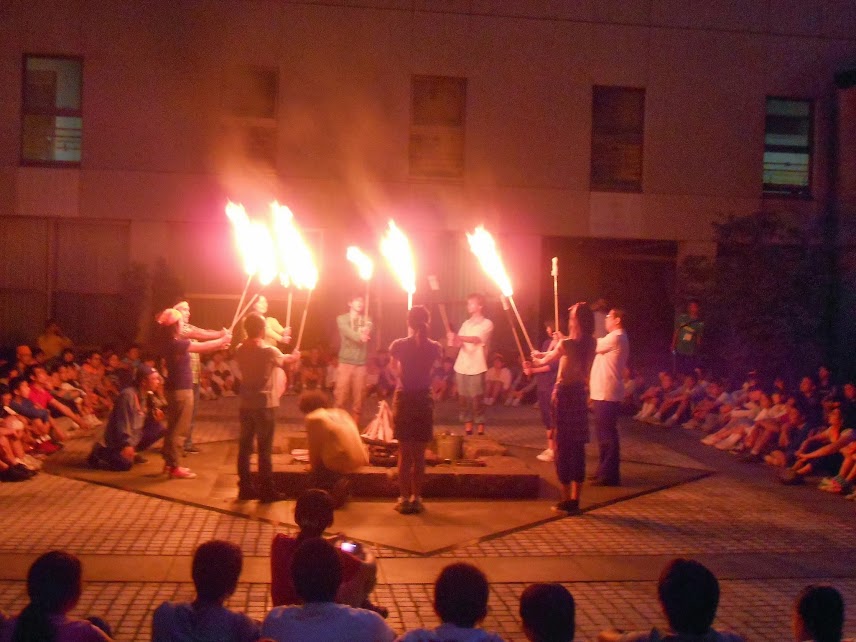
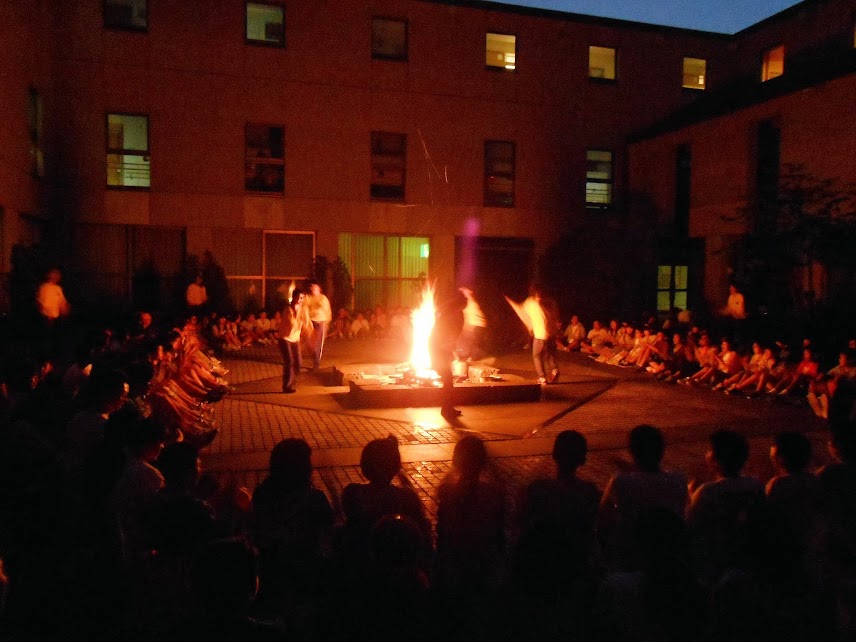
CAMPFIRE!!! :D Apparently the students from many of the other rounds missed out because of bad weather on their second day. They had rainy weather plan B instead, which involved indoor games, and definitely no campfire. It was an epic ceremony-like event, initiated by some of the captains lighting the fire with torches, and involved everyone dancing the hokey pokey around the campfire. Captains, who were instructed at a previous group meeting, danced it twice because we first showed the kids how it was done :D It was so much fun, and so many memories created.


The campfire got us all revved up for the final instalment of the day, the performance we had been rehearsing so intensely for. Our round had so many students (and subsequently so many groups) that we had to split into two groups in order to get through everyone. Everyone's performance was indeed unique and fun to watch, and all the kids did very well particularly considering the limited time they had to rehearse.
I taught my kids the kookaburra song. I can't show pictures of the kids performing on this public blog, but here's the song from YouTube to give you an idea of what they did. I added a bit of my own improvised accompanying gestures.


Day 3(2.5?)
Presenting the bandana signed by all the captains to the birthday boy

The final day of the camp, or more like final half a day. We left the campsite in Nasu city pretty early, to go to an amusement park called Rindoh lake family ranch. I'm not sure why, but the captains were encouraged to let their kids go off on their own, and to explore the park with other captains instead. Hearing from captains from the other rounds, being  asked to separate with our group at the amusement park was a very unusual thing since it seems in all the other rounds, the captains were responsible. Oh well, I'm not complaining. We captains spent a bit of time at the petting zoo with the sheep and alpacas.

We had lunch in the amusement park, again all the captains eating separate from the kids. The meal was a nostalgic return to Hokkaido, eating Genghis Khan. It was nice to have lamb, a rare meat form in Japan.

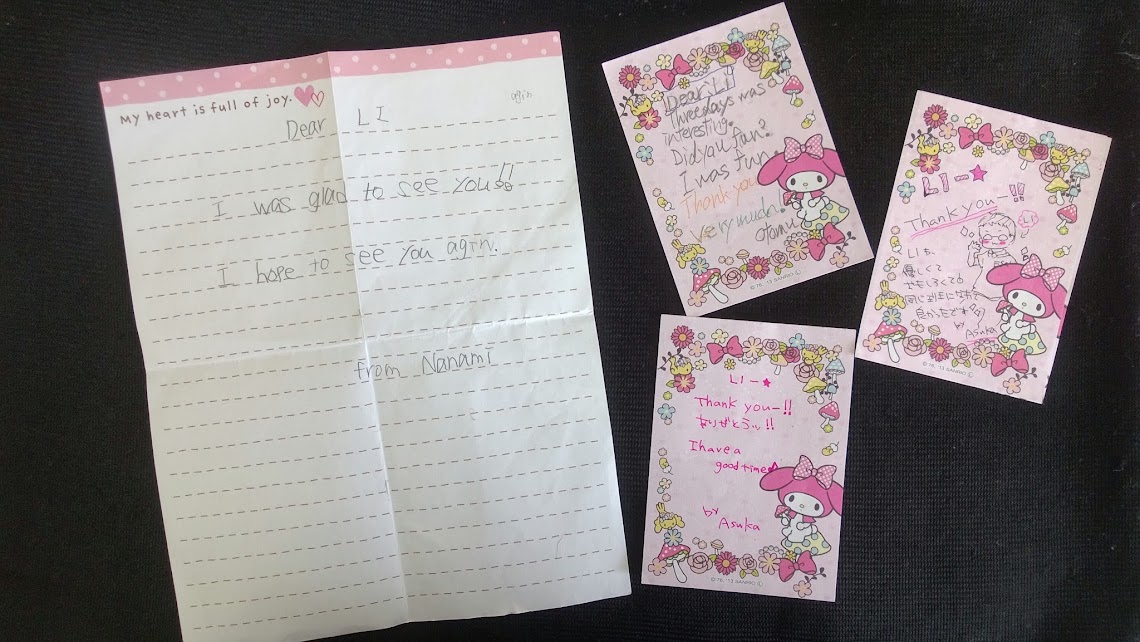
After we left the amusement park, we boarded the bus for what we realised was the final time. Captains sat with their group's kids, and I exchanged farewell messages with my group on the way back. I was happy to see that the messages I received were written in English. They tried very hard indeed, and made progress over the course of this camp. I'm very proud of them! I hope this experience serves as an inspiration for them to keep trying, and maybe one day I'll meet them again.


I'm very thankful toward my kids who were hospitable to me during mealtimes, proactively offering me tea and taking my dishes after the meal. I'm also thankful to the co-ordinators of this camp, who put in so much effort to make it happen. I think it's a great thing they're inspiring the kids of the future to become global citizens. This camp far exceeded my expectations for how rewarding and fun it would be. Time allowing, I definitely hope to participate again next year.

Wednesday, 11 September 2013

Summer Vacation Aikido Club Retreat

Last weekend, the TUFS aikido club went to Niigata Prefecture for a club retreat. The full duration of the camp was Friday to Tuesday, since university students are still on holidays, and will be until the beginning of October. However, since the Japanese language centre where we are being educated runs on a different schedule, our lessons began start of last week, so us exchange students could only attend the camp over the weekend. Even so, I had a great time developing my aikido, and developing relationships with the other members of the aikido club.

Each day we had a training session in the morning and one in the afternoon, both of two hours duration. Not only students from the TUFS aikido club attended this camp - aikido members affiliated with the university but who attend either the NHK aikido club or the Aikido International Headquarters dojo also came to train with us. In total, there were about 20 people in attendance during the weekend. As a result, I had the opportunity to practice with a variety of styles and learn to adapt to different personalities, not just rehash rote learned sequences. As a result of the camp, I feel that performing each technique has become more natural, and consequently more effective. One of the important lessons our aikido sensei taught us was to be responsive to the signals that our opponent is sending, most of which they are performing subconsciously. By tuning ourselves with our opponents' movements, we can literally effortlessly bring them under physical submission. Of course, this theory will take many years of practice to refine.

I was too busy practising aikido to take photos, hehe. But instead, here's some footage of aikido taken at the university's martial arts exhibit at the beginning of the school year. This demonstration, performed by members of the TUFS aikido club, was to promote the club and encourage new members to join, so I think it's ok to help them publicise it. If you ever come to TUFS, consider trying out Aikido for yourself :)


And because we all love Hollywood, here's the aikido master who brought Aikido into the limelight - Steven Seagal.


Related Posts Plugin for WordPress, Blogger...